Born to Compete: The Seiko Prospex Speedtimer Automatic Chronograph
This article was originally published in the September/October 2022 Issue of the WatchTime print magazine.
Seiko won one competition long ago, more than half a century ago in fact, and in it lies the source of the Japanese manufacturer’s chronographic heritage. The story is well known among watch aficionados. In 1969, Seiko, Zenith and a consortium composed of Breitling, Buren, Dubois-Dépraz and Hamilton were vying with each other to build the world’s first automatic chronograph. Each competitor naturally wanted to be the winner. Although Zenith named its movement El Primero (the first), Seiko ultimately won.
At the beginning of 1969, while the Swiss were still working on prototypes, Seiko had completed the Seiko 5 Speedtimer Automatic Chronograph with Caliber 6139. Not yet fully aware of the historical dimension of its innovation, the Japanese company was simultaneously investing in a much more far-reaching project that would have repercussions not just for Seiko, but for the entire watch industry: namely, to create the world’s first quartz watch. The breakthrough, which Seiko viewed as revolutionary, plunged the Swiss watch industry into the Quartz Crisis.
Furthermore, the column-wheel chronograph mechanism, combined with equally wellrespected vertical coupling, worked so well in Caliber 6139 that it seemed like a perfect match. Like the aptly named “Magic Lever,” this technology is also used in modern automatic Caliber 8R46, which ticks in the current Prospex Speedtimer Automatic Chronograph SRQ037. In addition to the limited-edition Ref. SRQ035, the SRQ037 takes up the history of the 1960s in a retro-modern way.
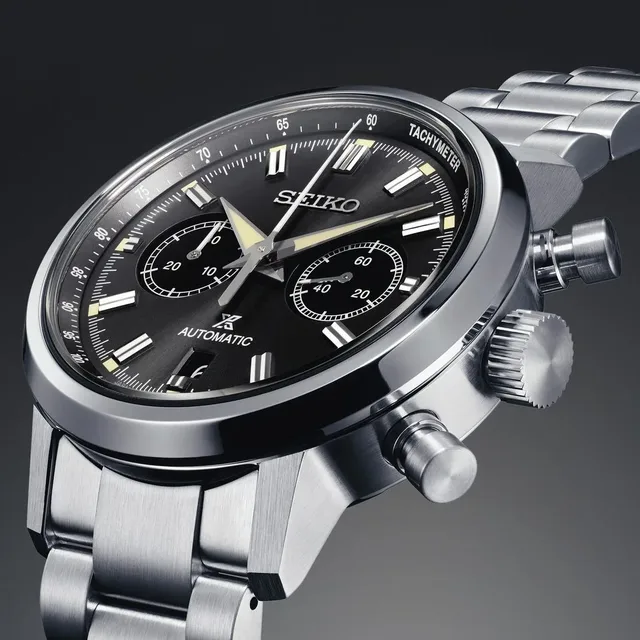
While the limited-edition Speedtimer reflects the stopwatch’s design from 1964 with its plain white dial, 10-second markers and the curved needle of its second hand, our test watch has a decidedly more contemporary look with an asphalt gray dial, large faceted applied indexes and dauphine hands. The tip of the white elapsed-seconds hand curves downward and sweeps meticulously along the outer edge of an elapsed-seconds scale, which is calibrated with three graduations between each full second stroke to match the 4-Hz rhythm of Caliber 8R46. This calibration is just as perfect as the switching of the underlying column-wheel technology and its integrated vertical coupling. The latter ensures that the elapsed-seconds hand always starts running without stumbling and stops running just as precisely.
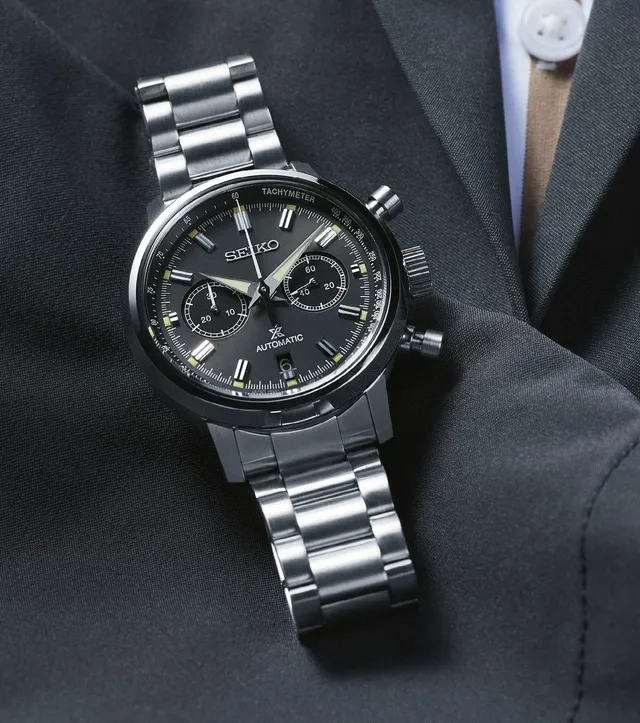
Thanks to Seiko’s state-of-the-art MEMS technology, parts for watch movements can be manufactured with much greater precision today than was possible 50 years ago. Caliber 8R46 belongs to Seiko’s most advanced chronograph series 8R. But unlike Caliber 8R48, it has two rather than three subdials, along with a date window at 6 o’clock. These displays give the dial a graceful symmetry and a clear bicompax arrangement with a subdial for the seconds at 3 and a counter for 30 elapsed minutes at 9.
Unlike most chronograph calibers, where the hand above the elapsed-minutes counter jumps ahead when the elapsed-seconds hand passes the zero mark, here the tallying hand advances smoothly. This detail is as unusual as the counter’s position at 9 rather than at 3, where this watch has the continuously running seconds. The fine and precise graduations on both railway-style counters are also noteworthy as are the impeccable strokes of the elapsed-seconds scale along the edge of dial. All three scales ensure optimum readability.
Despite the sparkling applied hour markers and the faceted main hands, the time is easy to read. The Lumibrite on the hour markers and hands appears retro beige during the day, but glows a turquoise blue at night.
The beveled and notched hour markers, the sharply pointed hands, the markers on the flange and the chronograph pushers are all patterned after a 1964 model called the Crown. The little top hats on the pushers accentuate the Speedtimer’s retro appeal. They also control the chronograph’s functions smoothly and precisely thanks to the underlying column-wheel technology.
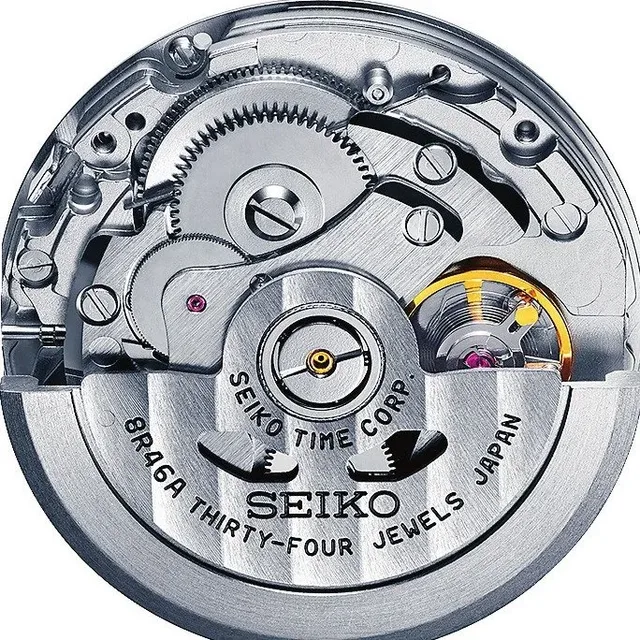
Unfortunately, contrary to expectations, neither the switching processes nor the action of the Magic Lever can be viewed through the sapphire crystal in the back of the case. Seiko’s reliable bidirectional pawl winding mechanism efficiently tightens the mainspring regardless of which direction the rotor is turning. The barrel stores enough energy to keep the watch running for up to 45 hours, which seems a bit short by today’s standards.
Seiko gives this model ample leeway with regard to the accuracy of the rate. The manufacturer specifies that it will neither lose more than 15 seconds nor gain more than 25 seconds per day. In reality, Caliber 8R46 runs much better; we measured daily deviations of between 3.2 and 8.1 seconds on the timing machine and 3.8 seconds on the wrist, which is still within modern standards.
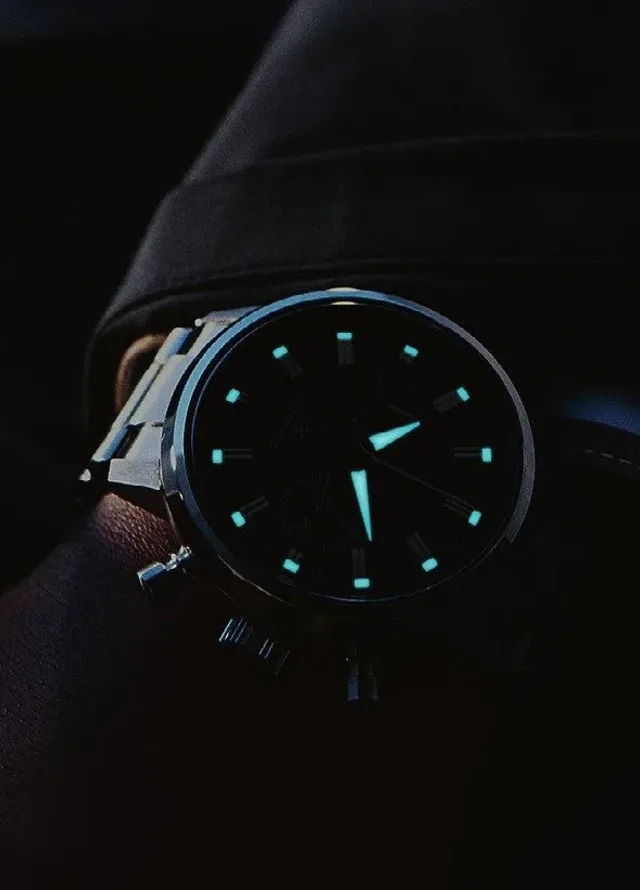
While the case has a retro look, Seiko also uses modern technology for the case. The robust stainless-steel housing has an especially hard coating using Seiko’s proprietary surface treatment, which makes the case three times more scratchresistant than ordinary stainless steel. The same hardening treatment is also used for the threerow stainless-steel bracelet, which Seiko designed especially for this series. The ensemble makes a strong impression in its own way and weighs nearly 200 grams. When this much weight combines with a height of 15.4 mm and an ample diameter of 42.5 mm, the resulting timepiece is not the best choice for those with slim wrists. Nevertheless, the watch still looks only moderately large when worn. This may be due to the polished bezel, the black dial with instrumentlike scales and the tachymeter markings on the flange. However, the height can hardly be concealed in view of the steep and massive strap lugs. Therefore, the Speedtimer sits quite prominently atop its wearer’s wrist. But those who feel that the stainless-steel bracelet makes the whole ensemble a bit too heavy can switch to the black leather strap that comes with the watch, but without a quick-change system.
In the competition among today’s chronographs, the Seiko Speedtimer takes its place with models from Zenith, Hamilton and Breitling, where it primarily distinguishes itself with a moderate price. You can get this stainless-steel timepiece and its manufacture caliber for $3,000. For comparison, the Hamilton Intra-Matic Auto Chrono (Ref. H38416111) with an ETA-based movement costs $2,245. A Zenith Chronomaster Chronograph (Ref. 03.A384.400/21.M384) with the famous El Primero caliber is $9,000, while entry into Breitling’s world of manufacture movements with the Avenger B01 Chronograph on strap (Ref. AB01821A1C1X1) is priced at $7,500.
To learn more about Seiko, click here, and to subscribe to the WatchTime print magazine, click here.