
With Zeal: IWC Big Pilot’s Watch 43 Spitfire

This article was originally published in the November/December 2022 Issue of the WatchTime print magazine.
The IWC name has been inextricably linked with pilots’ watches for more than 85 years. The Schaffhausen-based company set standards in the development of this type of watch, which remains extremely popular today. IWC introduced its first “Special Watch for Aviators” in 1936. This was followed in 1940 by the Big Pilot’s Watch and in 1948 by the Mark 11, which went on to achieve cult status. The variety of models continues to the present day. All of IWC’s Pilot’s Watches combine properties that also make them well suited for use in daily life, which is probably why they are so popular. Their useful traits begin with a simple, clear design, which results in optimum legibility. The list of advantages continues with highly precise timekeeping and uncommon robustness. For example, these watches are built to cope with impacts, temperature fluctuations, magnetic fields and sudden drops in atmospheric pressure.

Like our test watch, new models of the Big Pilot’s Watch 43 Spitfire are available with a titanium case and black dial, but are also offered with a bronze case and green dial. Regardless of the color scheme, all of these Spitfires are inspired by historical military watches. IWC built many such watches for the British military, along with deck watches for the Royal Navy. The most famous of these is the aforementioned Mark 11, a navigation watch designed for Britain’s Royal Air Force. The Spitfire models in IWC’s current collection of Pilot’s Watches reflect precisely this chapter in the brand’s history and are accordingly named after the legendary British airplane that was flown by pilots of the Royal Air Force. More than 20,300 Spitfire aircraft were built between 1938 and 1948.
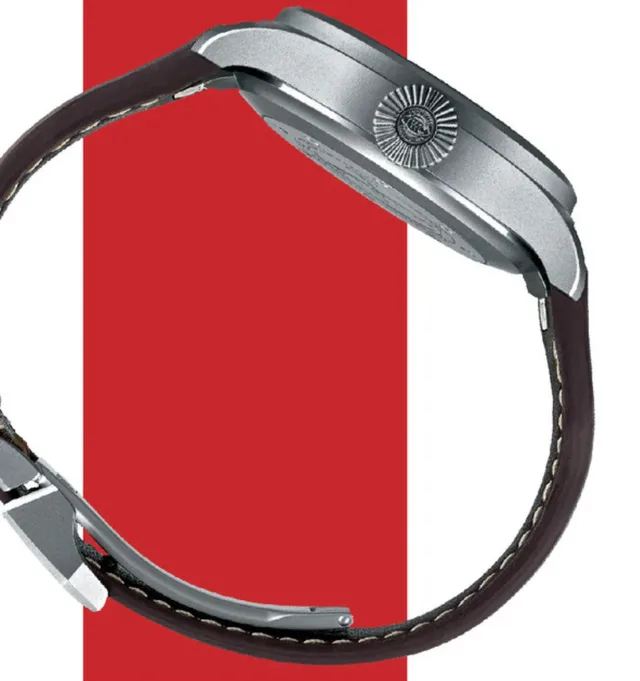
This airborne history explains why an engraving of the British-made fighter plane, which remained in service well into the 1950s, adorns the solid titanium back of the case of the new Big Pilot’s Watch 43 Spitfire. The threaded back seals the rear of the case, which is 43.6 mm in diameter and 14.6 mm in height, resists pressure to 10 bar and is made entirely of grade 5 titanium on its exterior, including the impossible-to-overlook conical threaded crown. Inside the titanium housing, a second case made of soft iron protects the movement of this watch from magnetic fields up to an intensity of 1,000 gauss. Further protection against magnetism is provided by the double back, the movementretaining ring and the dial, which has no window for a date display or other complication.
The large dial is approximately 37 mm in diameter and offers plenty of space for a clear and tidy design that fully upholds the standards of a professional pilots’ watch. The matte black and therefore non-reflective background contrasts boldly with the white scales on the edge of the dial. Large Arabic numerals show that the Big Pilot’s Watch 43 Spitfire follows a special design known as “model B” or observation watch. (The “B” here is an abbreviation for Beobachtung, which means “observation” in German.) Watches in this version were formerly used for navigational purposes because their dials were optimized to read the time with tothe-second accuracy.
The movement was engineered to keep time with optimum precision, while the large, clear dial relied on bold contrasts to maximize its legibility. The dials came in two variations: model A with large hour numerals and model B with large minute numerals. While the styling of model A follows the familiar design of classic pilots’ watches, model B, of which our test watch is an example, has hour numerals arranged less prominently in the inner area of the dial. The hours on the B version of the Big Pilot’s Watch 43 Spitfire are marked by an unobtrusive ring of 12 anthracite-colored Arabic numerals surrounded by a similarly gray circle. The numerals for the minutes are positioned between the anthracite hour circle and the bright white minute strokes, applied every 5 minutes, along the dial’s edge. The second variation of the Big Pilot’s Watch 43 Spitfire has a bronze case and a green dial. Styled according to model A, it features large white hour numerals positioned near the edge of the dial.

The traditional B design makes it easier for pilots, and everyone else, to read the minutes and seconds at a glance. This capability is also useful in everyday life. Apart from the fact that the passing seconds are clearly shown by the beige tip of the needle-like second hand, which sweeps exactly between the gray hour circle and the white minutes and seconds scale along the dial’s rim, this Spitfire also makes it easy to set the time to the nearest second. To do so, you halt the second hand at the instant when the tip is tangent to the dot-flanked triangle at the 12. This task is helped by the interplay between the threaded conical crown, which is large and easy to grasp, and the built-in stop-seconds mechanism, which instantly halts the second hand. A similar procedure can be used to set the time at the full hour: Simply turn the minute hand until it points vertically upward, then restart the movement by pushing the crown inward when a time signal announces that the full hour has arrived.
The triangular “zero index” provides orientation by clearly marking the dial’s topmost position at the 12, even in the dark. The top of the triangle points to the full hour or minute, while the two dots beside it mark the 59th and the first minute or second of each hour or minute. The precision is exactly as you would expect from a professional pilots’ watch. To enhance orientation in dark cockpits, a luminous triangle, which points upward, flanked by two dots, which also glow in the dark, were placed on the dials of numerous pilots’ watches in the late 1930s. This arrangement later became a mandatory item in the list of specs for a pilots’ official observation watch, also known as model B. The triangle and two dots on the dial of our test watch, along with the three other IWC-typical indexes at the 3, 6 and 9 and the two lanceshaped main hands, are filled with a beige luminescent paint that glows in a vibrant shade of green in the dark, lasting for a long time. The tip of the second hand is also colored in this retroinspired beige hue, but this hand doesn’t glow in the dark. Like the dial, the case of a classic pilots’ watch should be neither shiny nor reflective. That’s why IWC makes the entire case from matte, lightweight but sturdy grade 5 titanium. The dark gray satin finish results from an elaborate surface treatment in which the components are first polished and then sandblasted.

The characteristic brown calfskin strap with contrasting stitching, which we’ve already seen on other IWC watches, is securely held between the downward curving lugs of the unmistakable Pilot’s Watch case. A comfortable fit, even on a slender wrist, is assured by the combination of downward curving lugs at one end of the wristband and a titanium folding buckle, hinged on one side only, at the strap’s other end, which is perforated to accommodate a tang.
We are already familiar with the new EasX-Change strap-changing system from previous IWC watches. This system enables the wearer to change the strap by simply pressing a button and without needing additional tools. EasX-Change should be part of the equipment of this model, but the strap of our test watch was installed between the lugs without the EasX-Change mechanism. Be that as it may, a variety of leather and rubber straps are available for the Big Pilot’s Watch 43 Spitfire.
No matter who wears our test watch, and on which strap, the Big Pilot’s Watch 43 Spitfire always loses a few seconds per day. Our timing machine confirmed this minimal daily loss, which is a small drawback for the otherwise modern automatic manufacture Caliber 82100.
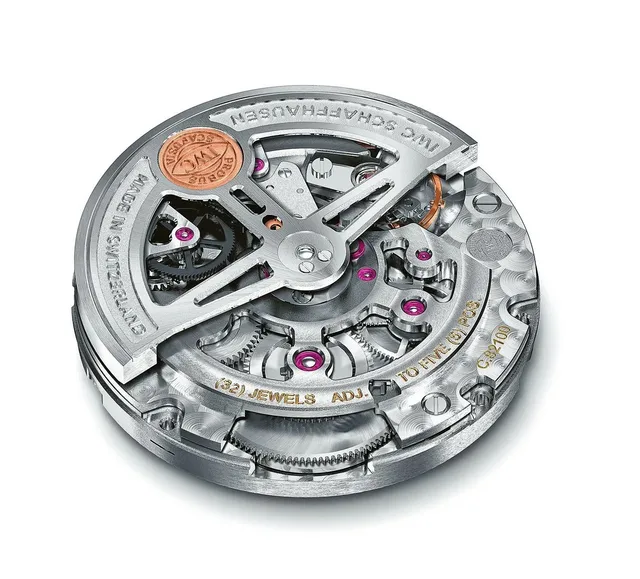
Caliber 82100 belongs to the 82000 Caliber family, which IWC began producing in 2017 to meet the need for a no-frills basic caliber. IWC’s 82000 movements replace the formerly used ETA- or Sellita-based calibers and are manufactured inhouse. The first 82110 version was introduced in an Aquatimer in 2017. Caliber 82200, which was launched in a Da Vinci in 2018, has a subdial for the seconds. The 82100 version inside the Big Pilot’s Watch 43 Spitfire has a central second hand, like Caliber 82110, but no a date display. Another version with sweep second hand and GMT function was introduced as Caliber 82710 in 2019.
All modifications are equipped with a new double-pawl version of IWC’s patented Pellaton winding technology. This shock-resistant and highly efficient automatic-winding system was developed in 1950 by Albert Pellaton, who was IWC’s technical director at the time. The updated system includes two pawls so that the rotor can transfer kinetic energy in both its directions of rotation, thus efficiently tautening the mainspring. The fully wound mainspring can keep the movement running for 60 hours.

Over the years, IWC has optimized Pellaton’s invention so that the pawl-winding system is always technically state of the art. As with the 52000 Caliber family, the most heavily stressed components, such as the bearing for the rotor, the self-winding wheel and the pawls, are made of black zirconium-oxide ceramic. Thanks to the use of this high-tech material, the winding mechanism is nearly 100-percent wear free. The balance, which needs no index to finely adjust its rate, is equipped with a flat hairspring and oscillates at a frequency of 4 Hz. Skeletonized components, such as the oscillating weight and the large bridge beneath it, reveal a movement that has been handsomely decorated with circular graining and côtes de Genève, yet still has a technical look.
Although the embellished movement is concealed from view behind the closed titanium caseback, it completes the equipment roster of the Big Pilot’s Watch 43 Spitfire, which stands out as a pilots’ observation watch with a simple, functional design and a special, easy to-read dial, and is still comfortable to wear despite its large and robust case.
To learn more about IWC, click here, and to subscribe to the WatchTime print magazine, click here.