Sponsored: Meet the Sopwith Aero Marquis Thomas-Morse Scout Limited Edition
The rarest of the rare
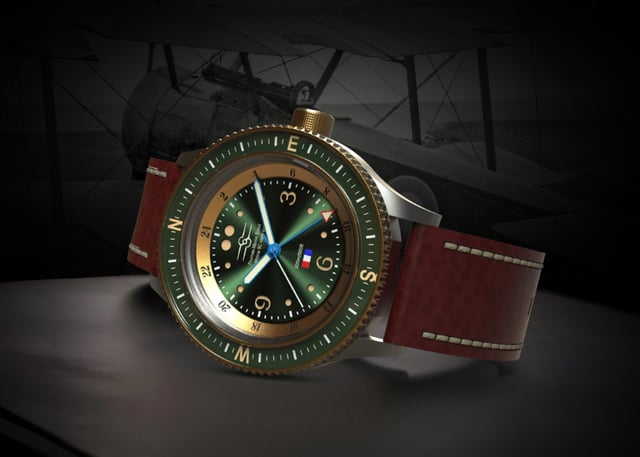
Forged from one of the scarcest aircraft engines in existence, the Sopwith Aero Marquis Thomas-Morse Scout Limited Edition is the pinnacle of the Aero Marquis collection — a watch whose case material is so rare that only 30 will ever be made, and whose specifications were elevated to match the extraordinary significance of its steel.
There is no more fitting word for the Sopwith Aero Marquis Thomas-Morse Scout Limited Edition than irreplaceable. Every watch in the Aero Marquis collection carries a powerful provenance story, but the Thomas-Morse Scout occupies a category entirely its own. Its case is manufactured from the steel pistons and valve guides of a Le Rhône 9C rotary engine — the very powerplant that defined America’s most important pursuit trainer during the First World War. The scarcity of the airplane, the engine, and the surviving material from which this watch is forged places the Thomas-Morse Scout edition at the summit of Sopwith’s lineup, both in rarity and in price.
To understand what makes this watch so exceptional, we must understand the airplane — and the engine — from which it was born.
America’s First Fighter
The Thomas-Morse S-4C Scout was the finest single-seat military aircraft produced in the United States during World War I. Designed by Englishman Benjamin Douglas Thomas, who had previously helped create the legendary Curtiss JN-4 Jenny, the Scout was a compact, nimble biplane built in Ithaca, New York beginning in 1917. Pilots called it the “Tommy.” It was their introduction to the violent, three-dimensional world of aerial combat.
The Thomas-Morse Aircraft Company produced approximately 497 S-4B and S-4C Scouts for the U.S. Army Signal Corps and a small number for the Navy. Though the American Expeditionary Forces were forced to adopt the more advanced British and French fighters already proven over the Western Front, the Tommy served at nearly every pursuit training school in the country — Carlstrom Field in Florida, Gerstner Field in Louisiana, Rockwell Field in California. It was the airplane in which an entire generation of American fighter pilots learned their trade.
After the Armistice, surplus Tommies were sold to civilian pilots and flying schools. A handful found second careers in Hollywood, appearing in such classic aviation films as Hell’s Angels and Dawn Patrol, standing in for the frontline fighters that never left Europe. But attrition was brutal. Constructed of wood, fabric, and wire, most Scouts simply did not survive the intervening century.
Ten Out of Six Hundred
Of the roughly 600 Thomas-Morse Scouts produced across all variants, approximately ten are known to survive today. They are scattered across a small number of American aviation collections from Long Island, New York to Chino, California. A rare airworthy example resides at the Western Antique Aeroplane and Automobile Museum in Oregon. One more — painstakingly restored over fifteen years by the Ithaca Aviation Heritage Foundation — flew again in 2018, a century after it was built. A handful of others exist as fuselages, partial restorations, or composites of surviving parts.
These are not airplanes that come to market. They are museum pieces, institutional holdings, and private treasures that change hands perhaps once in a generation. Securing any component of a Thomas-Morse Scout — let alone engine steel — is an undertaking measured in years and relationships, not catalogs and invoices.
The Heartbeat of the Tommy
The heart of the S-4C was the 80-horsepower Le Rhône 9C, a nine-cylinder rotary engine of French design. In a rotary engine, the crankshaft remains stationary while the entire bank of cylinders and the crankcase spin around it, pulling the propeller with them. It was a radical, elegant, and ultimately doomed concept, as the gyroscopic forces and oil consumption made rotaries impractical beyond the war years. But in 1918, the Le Rhône 9C was among the most reliable powerplants available to American aviators.
The Le Rhône engines fitted to American-built Scouts were not imported from France. They were manufactured under license in the United States by the Union Switch and Signal Company of Swissvale, Pennsylvania — a firm better known for railroad equipment, pressed into aviation service by the emergency demands of wartime production. These American-built Le Rhône 9C engines represent a remarkably specific intersection of history: a French-designed rotary, built by a Pennsylvania railroad equipment manufacturer, installed in an American fighter trainer designed by an Englishman formerly of the Sopwith Aviation Company.
The number of Union Switch and Signal Le Rhône 9C engines that survive today is vanishingly small. A few examples exist in museum collections or installed in surviving aircraft. One powers the airworthy Scout in Oregon. The Smithsonian’s National Air and Space Museum holds a Le Rhône 9C, though not on public display. When these engines surface, they are immediately absorbed by restorers, museums, and serious collectors of First World War aviation material. The steel pistons and valve guides from which the Sopwith Aero Marquis Thomas-Morse Scout case is forged represent a quantity of Le Rhône 9C material that, once consumed, cannot be replaced at any price.
Why the Finest Components Were Non-Negotiable
Sopwith Watch Company’s founder, Stephen Cox, is characteristically direct about the decision to equip the Thomas-Morse Scout edition with the best available specifications. “We may never have material from an American Le Rhône again,” Cox said. “There is no warehouse, no supplier, no second chance. When we realized how little steel we had recovered, and how impossible it would be to find more, the decision was immediate. We had to use the finest movement and the finest components available to us. We were not going to waste the few pounds of Thomas-Morse Scout engine steel we had on anything less than a first-class watch. So we went all out.”
That philosophy shaped every specification of the Thomas-Morse Scout Limited Edition. Where material is this scarce, there is no tolerance for compromise.


The Movement
Powering the Thomas-Morse Scout is the Mecaline Specialities Calibre 2893-A2, specified at the Swiss Élaboré grade, an upgraded tier of finishing and regulation that delivers improved accuracy of +/- 7 seconds per day and a 42-hour power reserve. Operating at 28,800 vibrations per hour, the movement drives hours, minutes, central seconds, and a dedicated 24-hour GMT hand for dual time zone tracking. The Élaboré designation is not merely a label; it reflects strict tolerances in assembly and adjustment, placing this calibre above standard-grade movements. For a watch whose case material is literally irreplaceable, nothing less was acceptable.
The Case
Every Sopwith watch case is manufactured in-house at the Sopwith Foundry in Houston, Texas. The process bears no resemblance to conventional watch case production. There are no bulk steel shipments from East Asian suppliers. No standardized blanks. Instead, the recovered Le Rhône 9C pistons are cleaned, metallurgically analyzed, and then individually melted and poured by hand — one case at a time. Each case is literally cast from a crucible of historic steel, shaped and machined on-site by Sopwith’s own technicians.
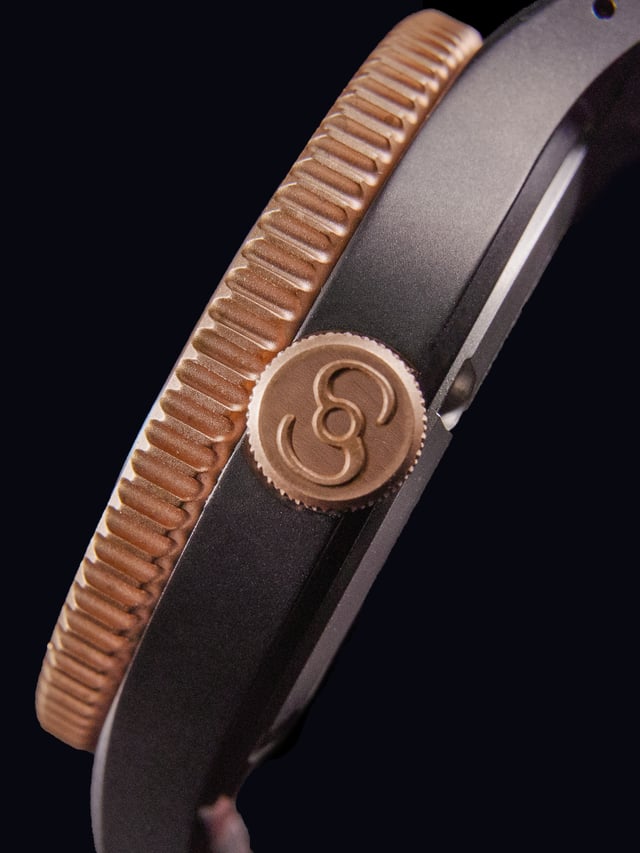
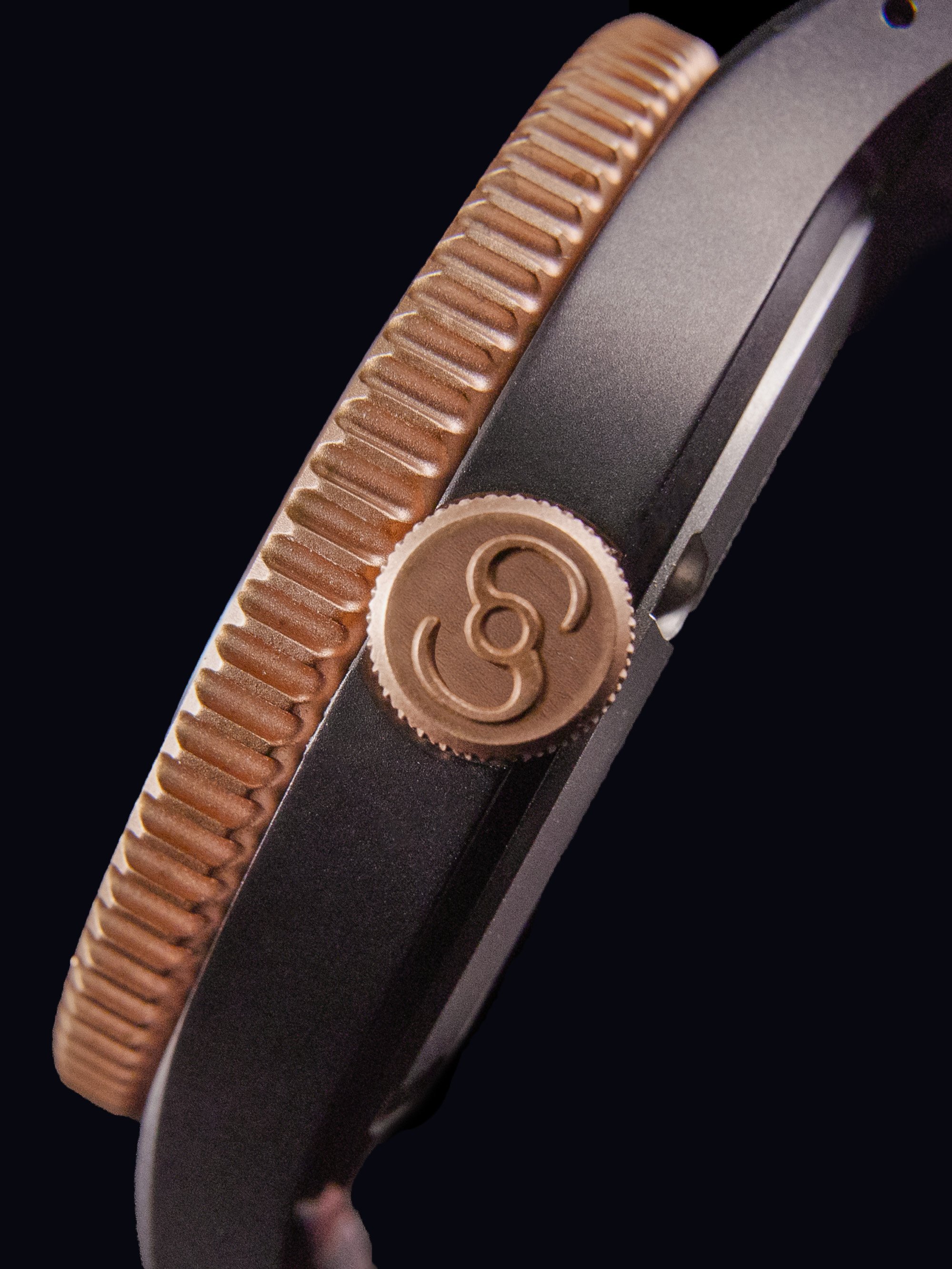
The Thomas-Morse Scout case measures 41mm in diameter with a 49mm lug-to-lug span and a 20mm lug width. After casting and machining, the case receives a bead-blasted finish followed by a titanium carbide PVD coating that elevates surface hardness to 1,500 Vickers — a rating that provides exceptional scratch resistance and protects the historic steel beneath. The case is fitted with a bronze screw-down crown with pronounced grip for easy manipulation, even while wearing gloves, and is paired with a 316L stainless steel caseback engraved with the Sopwith crest. Every Sopwith case is guaranteed forever.
Built to Endure
The Thomas-Morse Scout was designed as a rugged, forgiving trainer capable of absorbing the punishment inflicted by student pilots learning the most dangerous skill of their era. Sopwith built its namesake watch to the same standard of resilience. Water resistance is rated to 200 meters — more than adequate for swimming, snorkeling, or any water sport short of saturation diving. Anti-magnetic protection reaches 20,000 Gauss, rendering the movement essentially immune to the magnetic fields generated by phones, tablets, laptops, medical equipment, and the other invisible hazards of modern life. A 1mm raised box sapphire crystal protects the dial from impact and abrasion.
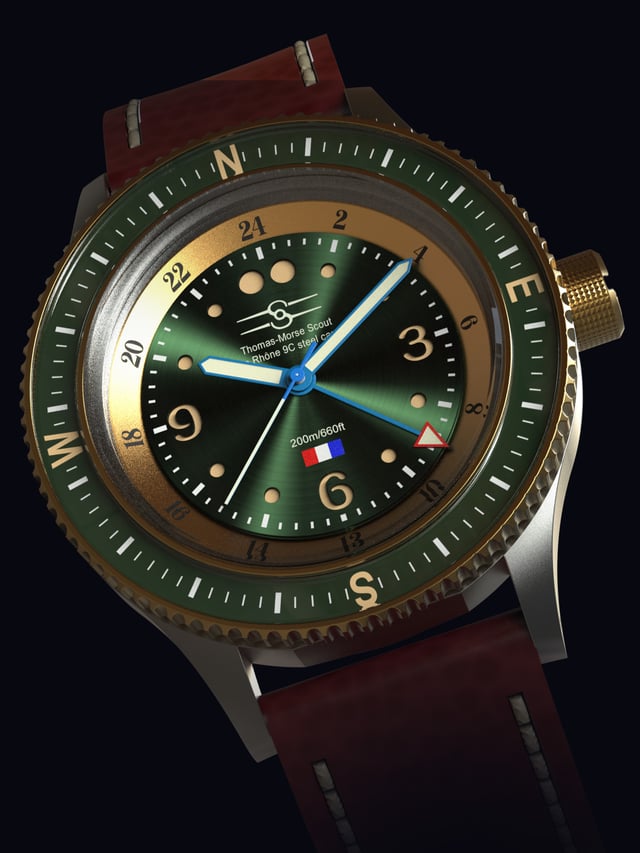
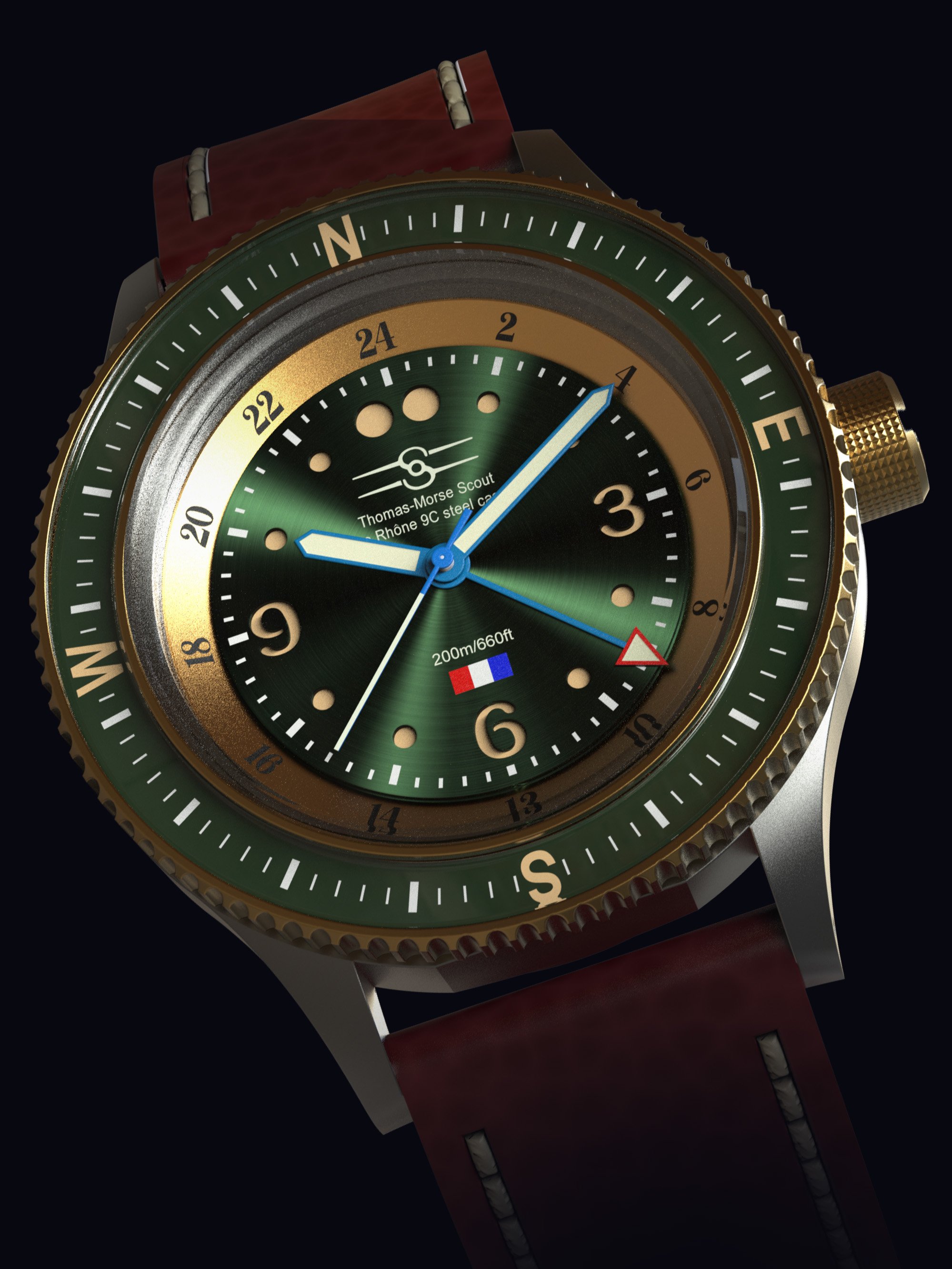
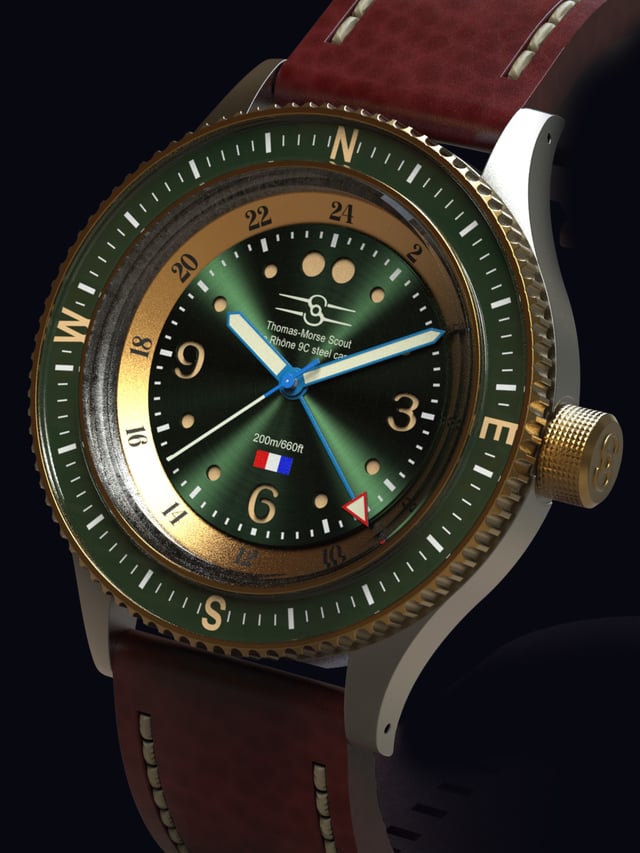
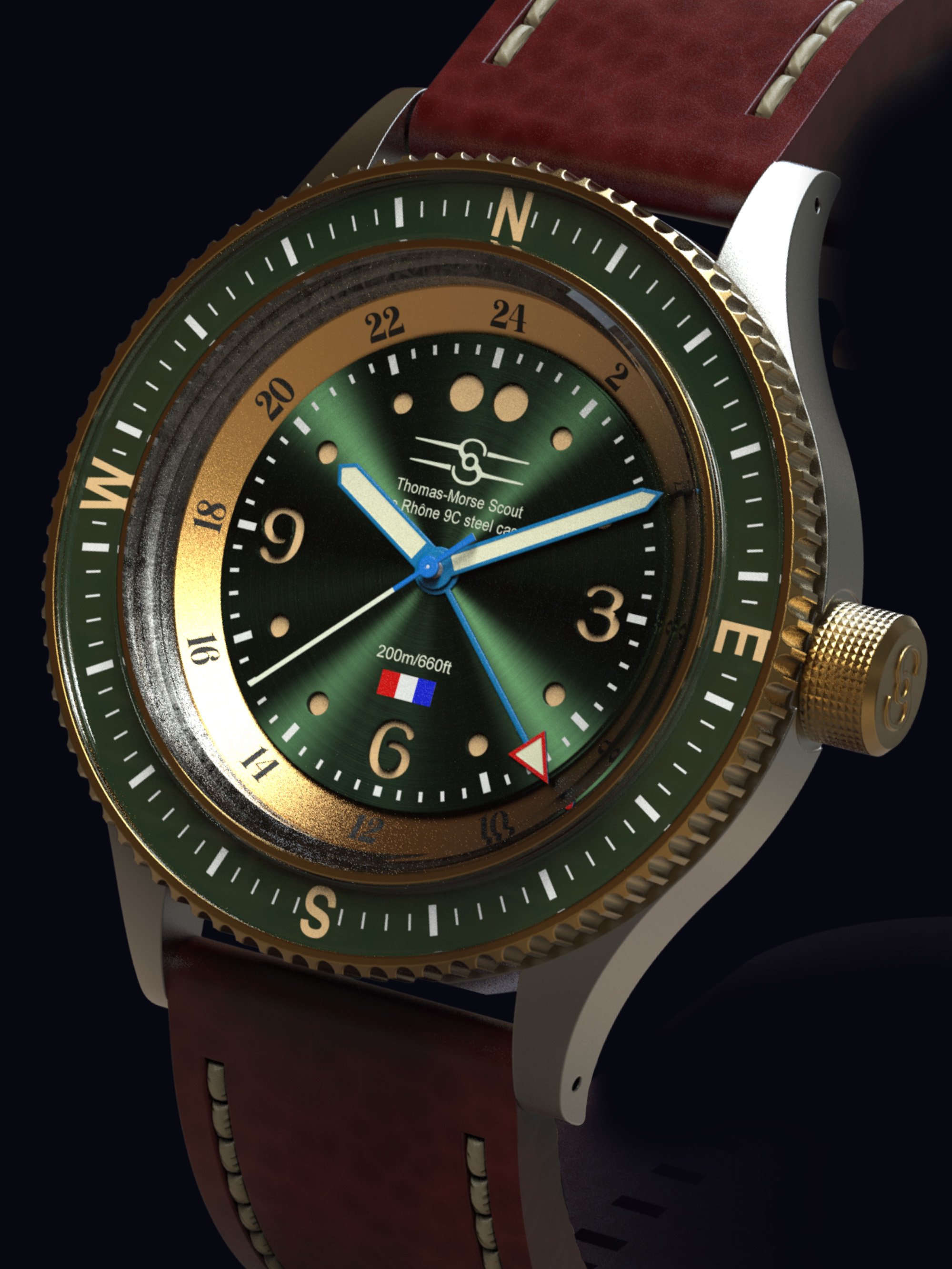
Above the case sits a 120-position unidirectional rotating bronze azimuth bezel with a luminous sapphire insert, providing solar compass functionality for direction-finding in the field. The bezel’s coin-edge grip ensures positive engagement even in wet or cold conditions.
The Dial
The Aero Marquis Thomas-Morse Scout features an Emerald Green sandwich-style dial, a multi-layer construction with stacked stainless steel plates that create visual depth and ensure legibility. The green and blue color combination is drawn from the original paint scheme of American Tommies. Mariner Blue hands complement the dial, while a 25-degree oblique bronze chapter ring carries the 24-hour GMT scale. A tri-color accent bar at 6 o’clock references the American national colors. Luminescent indices and hands ensure the watch remains fully legible in darkness.
Presentation
Each Thomas-Morse Scout is delivered on a stitched, hand-cut Horween leather strap and accompanied by a travel pouch handmade from vintage waxed leather. The watch is presented in a Sopwith signature book-style presentation box, designed to slide onto an office bookshelf and eliminate the collector’s perennial storage dilemma. The presentation box is made from pure French walnut planks, the same material used for the Scout's original propellers in 1918.
An authentication book accompanies every watch, documenting the precise Le Rhône 9C components used in the making of that specific watch case and the history of the Thomas-Morse Scout from which they came.
Sopwith’s distinctive vintage delivery experience includes original unused air mail stamps from the 1940s and hand-addressed 1930s mail tags, presented and delivered in accordance with the US Postal Service regulations of 1924.
Specifications
Model: Sopwith Watch Company Aero Marquis Thomas-Morse Scout Limited Edition GMT
Functions: Hours, minutes, seconds, GMT, azimuth
Case: 41mm diameter; 49mm lug to lug; 20mm lug width; enhanced historic steel forged from Thomas-Morse S-4C Scout Le Rhône 9C aircraft engine pistons and valve guides; bead-blasted finish with titanium carbide PVD coating; 1,500 Vickers hardness; bronze unidirectional 120-position azimuth bezel with luminous sapphire insert; bronze screw-down crown; engraved 316L stainless steel caseback
Crystal: 1mm raised box sapphire
Dial: Emerald green sunburst, three-piece sandwich construction, double stainless steel stack, oblique 25-degree bronze 24-hour GMT chapter ring, blue hands, luminescent indices
Movement: Mecaline Specialities Calibre 2893-A2 Élaboré; automatic; 28,800 vph; 42-hour power reserve; +/- 7 seconds/day
Water Resistance: 200 meters
Magnetic Resistance: 20,000 Gauss
Strap: Stitched, hand-cut Horween leather
Price: $10,500 USD
Edition: Limited to 30 pieces
The Sopwith Aero Marquis Thomas-Morse Scout Limited Edition is available for pre-order now at sopwithwatch.com.