Unstoppable: Highlights from the TAG Heuer Carrera Collection
In the early 1960s, Jack Heuer, freshly on the road as the watch company’s chief executive, traveled to a race in Florida that was timed by the family-run Ed. Heuer & Co. S.A., the 12 Hours of Sebring, held at Sebring International Raceway since 1950, on the site of the former Hendricks Army Airfield World War II air base. There he crossed paths with the Rodriguezes, whose two sons Pedro and Ricardo were determined to become successful Formula One racing drivers. They told him about the Carrera Panamericana, a border-to-border sedan rally racing event on open roads in Mexico (similar to the Mille Miglia and Targa Florio in Italy), widely regarded as the most dangerous race of any type in the world. And dangerous it indeed was: In 1955, after just five annual races, the Carrera Panamericana had to be canceled for good, although a less daunting version of the Carrera Panamericana was revived in 1988.
Heuer, himself a racing driver and motorsport enthusiast, was immediately intrigued by the challenge, speed and emotion of the race, and realized that it could be used as the name for one of his new lines of wristwatch chronographs, made specifically for motorsports. On top of that, the Spanish word “carrera” comes with multiple meanings and could be translated as “race,” “career” or simply “path.” In other words, 10 years before Porsche would come to the same conclusion, Heuer had found an ideal name for a watch with a racing spirit aimed at a young, stylish, upwardly mobile generation in tune with the increasingly liberated tastes of the 1960s. “I loved not only its ‘sexy’ sound,” said Jack Heuer of the Carrera name in his 2013 autobiography, “but also its multiple meanings.”
For Nicholas Biebuyck, TAG Heuer’s Heritage Director, these different meanings are perhaps best reflected in the yellow-gold Carrera Ref. 1158CHN that was worn by Swedish racing driver Ronnie Peterson (also known by the nickname ‘SuperSwede’): “On the back it’s engraved, ‘Success / Ronnie Peterson / from Jack W. Heuer.’ And it was the watch that Jack had presented to Ronnie Peterson. And as a result, the Carrera has become synonymous as this symbol of good luck, of success, of strength, of endurance, and doing your very best, basically.”
In 1963, the Heuer Carrera made its debut as a “precision watch styled for today’s living.” It was advertised to “the man of action” as a “new concept in chronographs,” capable of recording “precisely up to 12 hours and reads as close as 1/5 of a second or 1/100 of a minute.” On one hand, the Ref. 2447 — also known as the “Carrera-12” — was indeed a tool watch with a clean, uncluttered, ultra-legible dial, a reliable instrument to measure time and average speed while driving. On the other, it was also elegant, modern and rather clever. It was Jack Heuer’s idea, for example, to move the tachymeter scale onto the tension ring — an innovative device proprietary to the Carrera, which was used to hold the crystal in place and protect the watch from dust and water. “Car-fans” around the globe could even “choose an additional Tachometer scale in km or miles.”
The first Carrera generation was manufactured from 1963 to 1970, in various models that all shared the same overall design: a puristic, 36-mm “heavy duty stainless steel case” that was “fully waterproof" and came with straight lines and faceted lugs, another signature design element of the Carrera. In its center, a clean dial with raised applied batons for the hours and sunken registers, described as a “revolutionary 3-dimensional dial” offering “perfect legibility” in the company’s first ads for the watch. The goal clearly was (and still is) to focus everything on the essential function, the chronograph. Initially, all of these watches were hand-wound until around 1970 for obvious reasons, and most were assembled by what was then the largest manufacturer of stopwatches and chronographs (Heuer’s annual production had reached close to 400,000 pieces by 1970) with outsourced movements, such as the Valjoux 72 and Valjoux 92 before the arrival of the Calibre 11.
The rest, as the they say, is history. Jack Heuer didn’t have difficulties convincing Ferrari Formula 1 drivers like Niki Lauda, Ronnie Peterson and Arturo Merzario to wear his Heuer Carreras; off the track, the Carrera has appeared on the wrists of the likes of those such as Mick Jagger, James Hunt and Ryan Gosling (a brand ambassador since 2022). More importantly, 60 years after its introduction, the Carrera can be regarded as one of the first and certainly most influential watches developed for motorsports, and one of the most important watches with a chronograph. And, like different stages in a race Cup, the history of the Carrera has different chapters, mirroring TAG Heuer’s own story.
Inspired by the “Glassbox” Design
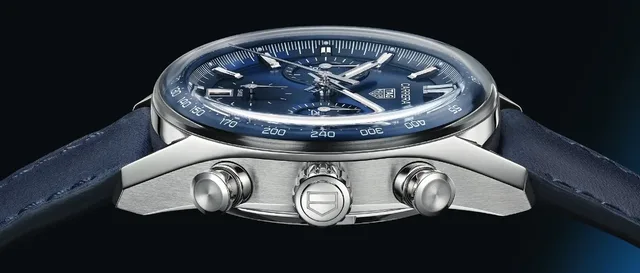
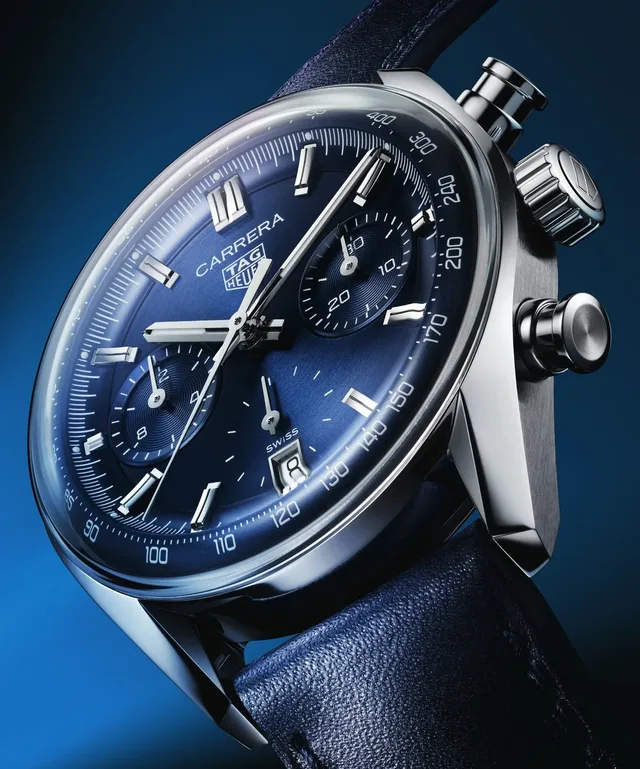
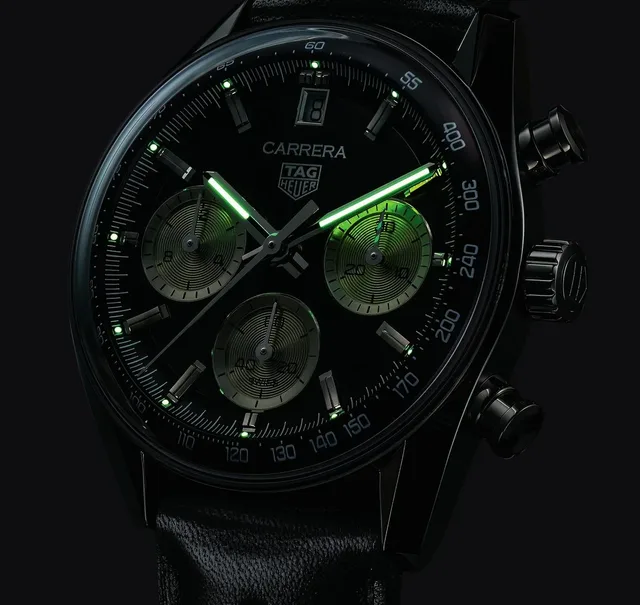
Fast forward to 2023: For the Carrera’s 60th anniversary, TAG Heuer introduced two new models, the 39-mm TAG Heuer Carrera Chronograph and the slightly larger TAG Heuer Carrera Chronograph Tourbillon, both of which have the potential to become keystone designs in the company’s collection. The 39-mm case of the chronograph-only model is topped with a sapphire crystal shaped like the domed hesalite crystals found on Heuer Carrera models from the 1970s, only now, the crystal has been redeveloped so that the curve flows seamlessly over the tachymeter scale that runs around the dial edge and into the case. In the same way, the flange and indexes have been curved, too, further contributing to the watch’s seamless aesthetic. It also means the tachymeter can be read from a wider range of angles.
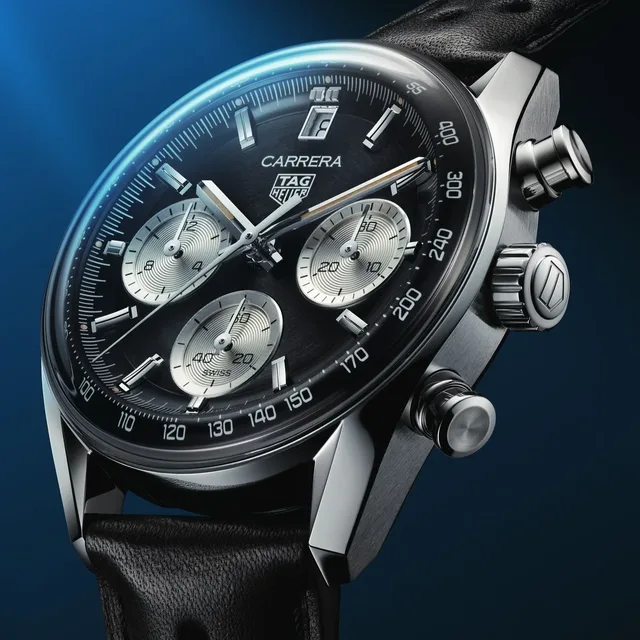
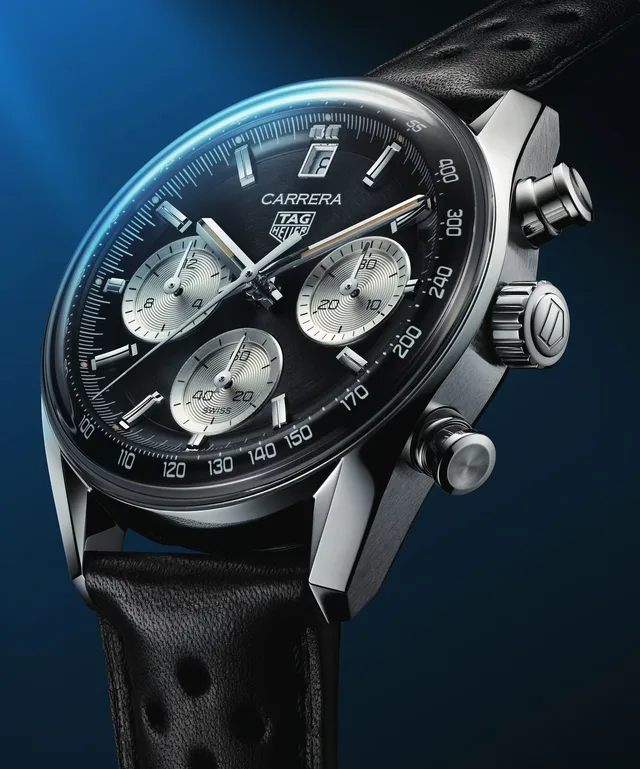
At launch, there are two models: one with a signature blue dial on a blue calfskin leather strap (Ref. CBS2212.FC6535), and a second with a racier, black-and-silver “reverse panda” dial (Ref. CBS2210.FC6534). The reverse panda model is described by TAG Heuer as “a greatest hits compilation of some of the most coveted Heuer Carreras of the 1960s,” such as the Ref. 3147 “Dato 12” with an unusual date a 12 o’clock, the first Heuer Carrera with chronograph and calendar functions, and the Ref. 2447 NS, perhaps the rarest Heuer Carrera of them all, with an extremely limited production run of just a few years. It comes on a black perforated calfskin leather strap.
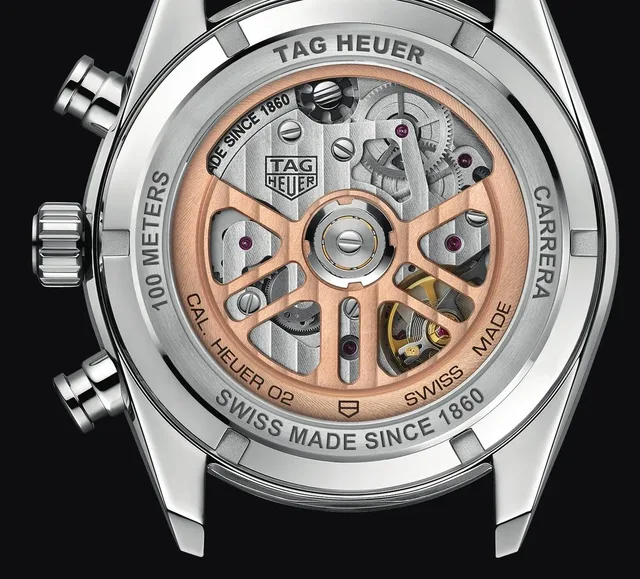
Inside both iterations of the TAG Heuer Carrera Chronograph is an updated version of TAG Heuer’s in-house automatic chronograph engine, the Heuer 02. Named TH20-00 and visible through the watch’s sapphire crystal caseback, the chronograph movement now features an oscillating weight offering bidirectional winding, whereas previous versions charged the movement’s mainspring only if the rotor moved in a counterclockwise direction. In daily use, it should deliver faster and more reliable winding, ensuring the watch is running closer to its maximum 80-hour power reserve and improving precision for more of the time it is in use. TH20-00 also has elevated finishings.
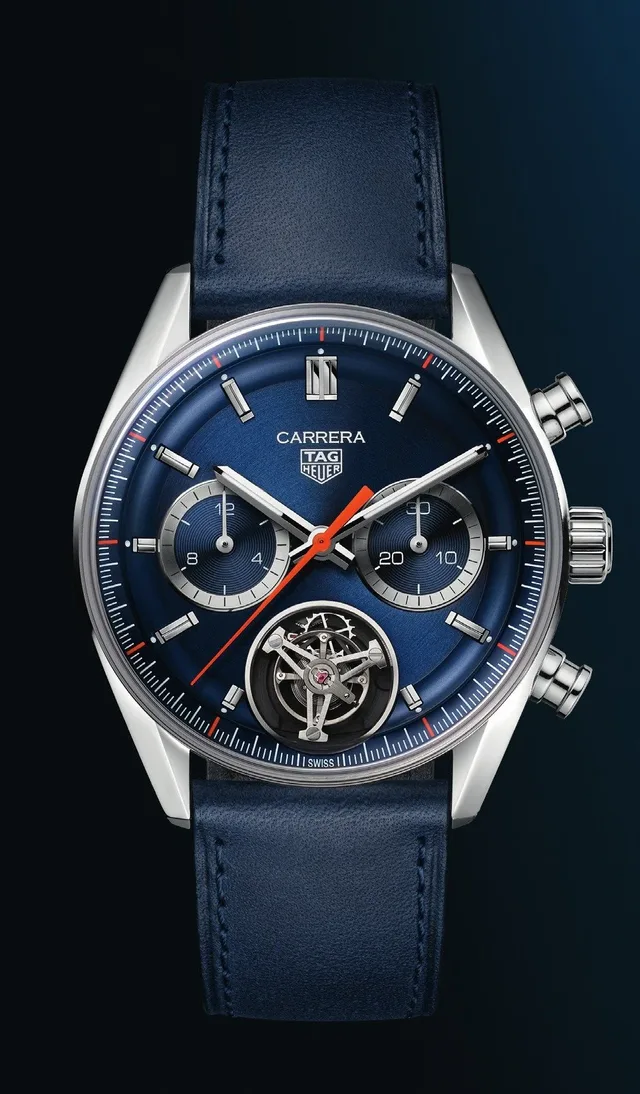
Speaking of elevated, TAG Heuer also added the 42-mm TAG Heuer Carrera Chronograph Tourbillon to its fleet (Ref. CBS5010.FC6543), with an aperture at 6 o’clock that reveals its tourbillon cage. This slightly larger stainless-steel watch is powered by TAG Heuer’s in-house tourbillon movement, the TH20-09. Needless to say, the chronometer-certified automatic movement also has a chronograph function, in this case backed by a 65-hour power reserve. The deep azure subdials are surrounded by high-contrast silver rings to make the chronograph readouts as legible as possible. In the same way, the minutes scale running around the outside edge of the dial is punctuated by orange detailing over each hour marker. A final, nostalgic touch is the chronograph’s central seconds hand, which has a triangular shape “inspired by 1960s racecar dashboard instruments,” according to the brand.
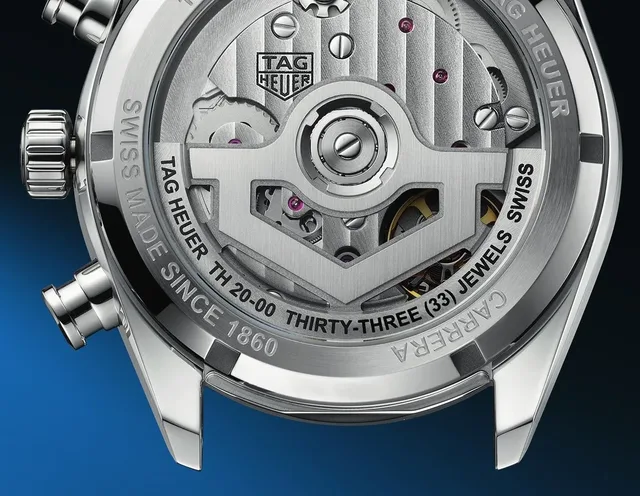
As with the TH20-00, the TH20-09 was created by TAG Heuer Movements Director Carole Forestier and the Swiss watchmaker’s technical teams, so that it now can deliver bidirectional winding, increased efficiency and accuracy, and a higher level of finishing. The movements are produced in TAG Heuer’s Chevenez site, a village and former municipality in the district of Porrentruy in the canton of Jura in Switzerland, a one-hour drive from its headquarters in La Chauxde-Fonds. The Tourbillon retails for $24,050, the smaller blue and black chronographs for an equally competitive $6,450 each.
Recalling Classic Race Car Speedometers
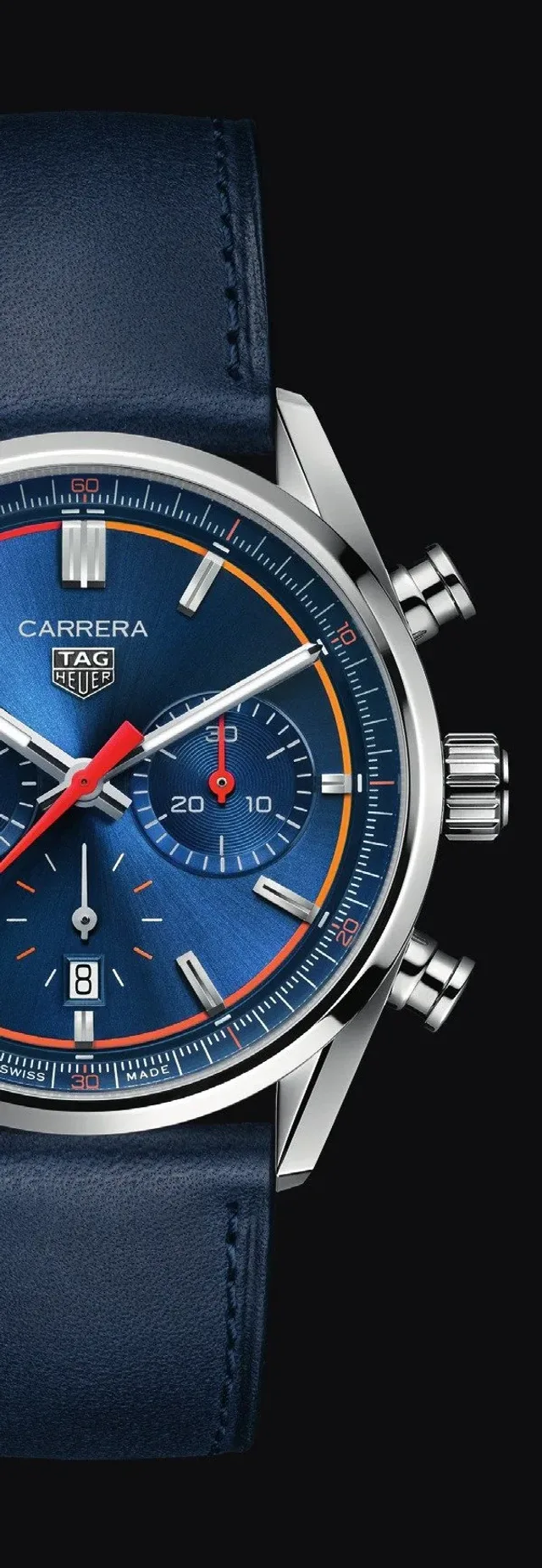
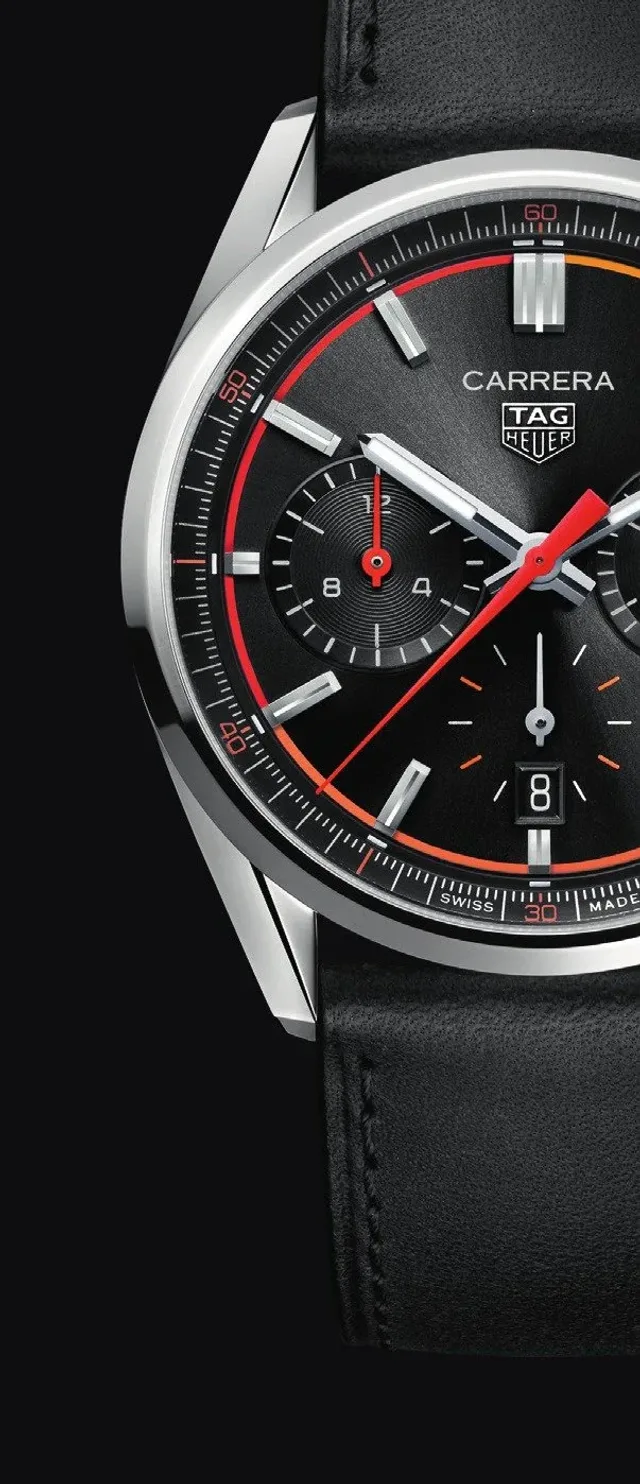
With an overall design that is even closer to the design of the original 1963 Heuer Carrera, TAG Heuer has also launched two new Carrera Chronographs in Geneva, both with 42-mm stainless-steel cases. The distinction is in the dial: There’s a choice of blue (Ref. CBN201D.FC6543) or black (Ref. CBN201C.FC6542), both decorated with vivid orange detailing (similar to the oscillating weight of the hand-finished piece for Only Watch 2021) that recalls classic race car speedometers. It runs around the edge of the dial and links the applied hour markers. Alongside this, the new central chronograph seconds hand and subdial hands are in a red inspired by sports car dashboards. Lastly, the alternate indexes on the small seconds at 6 o’clock and the 10-minute/10-second markers on the flange are in a fiery orange. The new models are also powered by TAG Heuer’s in-house automatic chronograph Heuer 02 movement, and come with calfskin straps. Retail is $5,750 each.
Staying Revolutionary
Ever since the legendary motorsport chronograph was brought back in 1996, TAG Heuer has used the Carrera to introduce groundbreaking ideas. The Carrera Plasma from 2022 (Ref. CBN5A90.FC6540), for example, uses the classic Carrera case in aluminum, along with a tourbillon, carbon hairspring and lab-grown diamonds, even for the dial. In 2014, the Carrera made headlines with the world’s most affordable Swiss-made tourbillon. It is therefore safe to say that the most recent releases are perhaps closer to Jack Heuer’s original vision than ever: a modern classic powered by an in-house automatic chronograph movement, perfectly balancing elegance, legibility and timeless design — with the tachymeter scale on the tension ring, obviously.
For Biebuyck, who has been working tirelessly on the upcoming book, The Tag Heuer Carrera: The Original Racing Chronograph in the past months, it is essential to understand “the kind of broader environment in which the Carrera and the watch industry were operating at the time.” To him, the new releases from 2023 therefore represent a shift that is “absolutely significant, because it gives us a brand new foundation to build the Carrera on top of again.” And he adds, “For the Carrera, we have these different chapters that represent different parts of the story. So I think as a result, we often see revolutions rather than evolutions. And I think for me, this case form is very much a revolution. It’s completely new for the design of the watch and for the industry. No one’s really done this thing of pushing the crystal all the way to the absolute limits again on an industrial scale, there’s no one else that has really done this.”
To learn more visit TAG Heuer, here.
This article is from the WatchTime Archives and was originally published in the July/Aug 2023 print issue. To subscribe to the magazine, click here.