Apr 4, 2015
Reading time 7 min.
Time Displays: Dresden’s Mathematics and Physics Salon

Dresden’s Mathematics and Physics Salon, with its scores of timepieces from Germany and elsewhere, reopened in 2013 after a six-year renovation. Norma Buchanan explored the hallowed halls in this feature article.
Well-traveled watch lovers are familiar with the celebrated watch museums of Switzerland, in La Chaux-de-Fonds, Geneva and Le Locle. But there’s another museum, less known in watch circles, that’s worthy of a watch fan’s attention. It’s the Mathematics and Physics Salon in Dresden, Germany.
As its name suggests, it’s much more than watches and clocks; it contains scientific measuring and observation instruments of all kinds, most made between 1550 and 1900. The museum shows how, during those 350 years, the quest for precise timekeeping was part of a broader quest for scientific knowledge of all types.
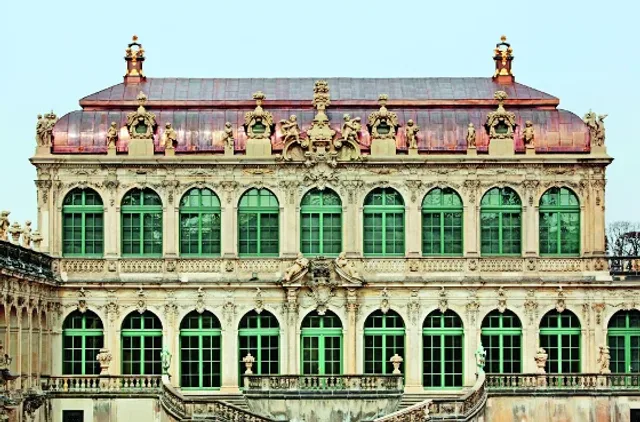
The museum, founded in 1728, is part of Dresden’s famous Zwinger Palace.
PR
The museum, once a regular stop for watch fans en route to the watchmaking town of Glashütte, less than 20 miles to the south, has been closed for renovation for six years. In April, it reopened, still housed in its elegant Baroque building in Dresden’s historic center, but now remodeled inside and fitted with computer animations and interactive kiosks that explain the often inscrutable objects on display: encryption devices, burning mirrors (used to focus sunlight so intensely that it could melt metal), a vacuum pump, telescopes, a mechanical calculator made by Blaise Pascal, carriage odometers, and on and on.
There are 400 objects on exhibit, chosen from the museum’s inventory of 2,500. Founded in 1728, the museum is probably the world’s oldest history-of-science museum that is still at its original site. It is part of the complex of museums housed in Dresden’s Zwinger Palace, built by the Elector Augustus the Strong, the ruler of Saxony (the state where Dresden and Glashütte are located), in the first half of the 18th century. (An elector was one of a group of princes within the Holy Roman Empire charged with tapping a new Holy Roman Emperor.)
The renovation was underwritten in part by A. Lange & Söhne, based in Glashütte. Lange has been a sponsor of the Dresden State Art Collections, of which the salon is a part, since 2006. (The company eschews most kinds of promotional sponsorships, preferring to spend its money on timepiece-related institutions and events, CEO Wilhelm Schmid said.) Lange, Saxony’s best-known watch brand, invited journalists from around the world to the official reopening.
The salon’s curator, Michael Korey, an affable, Chicago-bred, Princeton-educated mathematician, gave the reporters a tour of some of the museum’s highlights. They include:
- An ingenious clock made by the Dresden model-maker Andreas Gärtner (whose powers of invention earned him the nickname “the Saxon Archimedes”) around 1690, which gives the local time at each of the earth’s 360 lines of longitude. The clock face has within it 360 small clock faces, one for each degree of longitude. Each face has a single hand, hanging permanently down to the 6 o’clock position, and is labeled with a place name. A central movement turns all 360 faces at the same time, so that they rotate while the 360 hands remain stationary, always pointing to the correct local time at the faces’ designated longitudes.
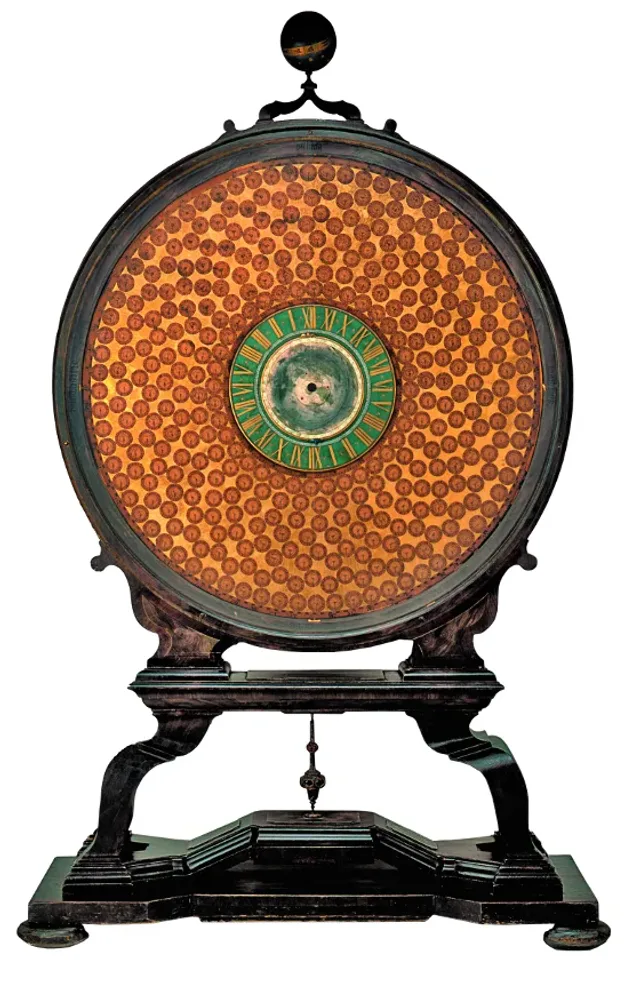
This universal clock from around 1690 has 360 small clock faces, one for each degree of longitude.
PR
- An astronomical clock commissioned by the Elector Augustus II of Saxony (great-great-great-grandfather of the Augustus who commissioned the Zwinger) and made in the German state of Hessen in the 1560s. The clock, which the museum’s restoration experts refurbished while the museum itself was being renovated, has eight dials that give various astronomical indications. According to Korey, it is “our ‘Sistine Madonna,’ the pinnacle of horology in the 16th century, the summation of mathematical astronomy.” (The “Sistine Madonna” is the world-famous painting by Raphael that is the star attraction of the Zwinger’s art collection.)
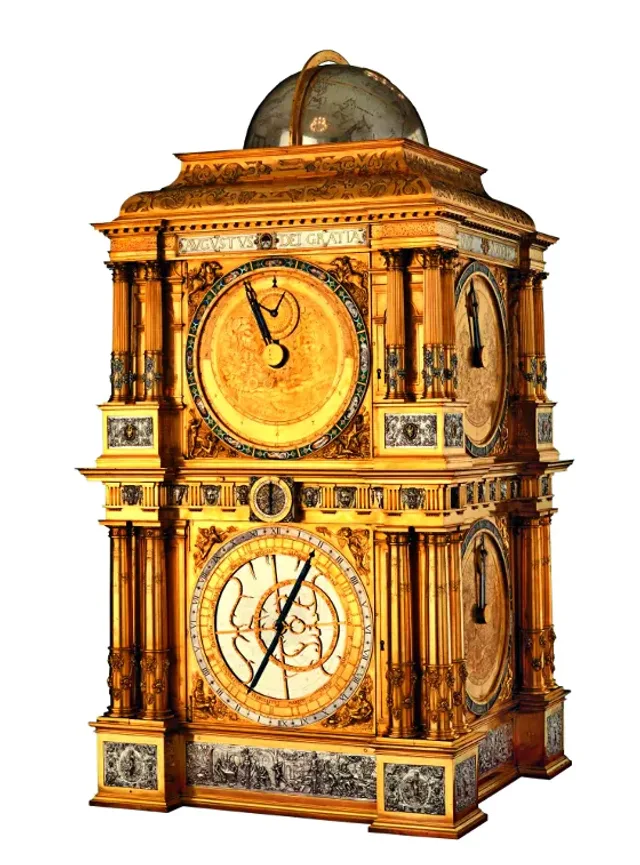
This astronomical clock from the 1560s is the museum’s pièce de résistance.
PR
- A bear automaton, from around 1625, equipped with an alarm clock in its chest. The bear’s eyes roll back and forth with the ticking of the clock. When the alarm goes off, the bear, which is more than three feet tall, beats his drum and his jaw moves up and down. Not only does he still work, Korey pointed out, but he even has his original fur. (The bear, and the museum’s other automata, are so old and fragile that viewers can see them work only on video displays so as to prevent damaging wear.)
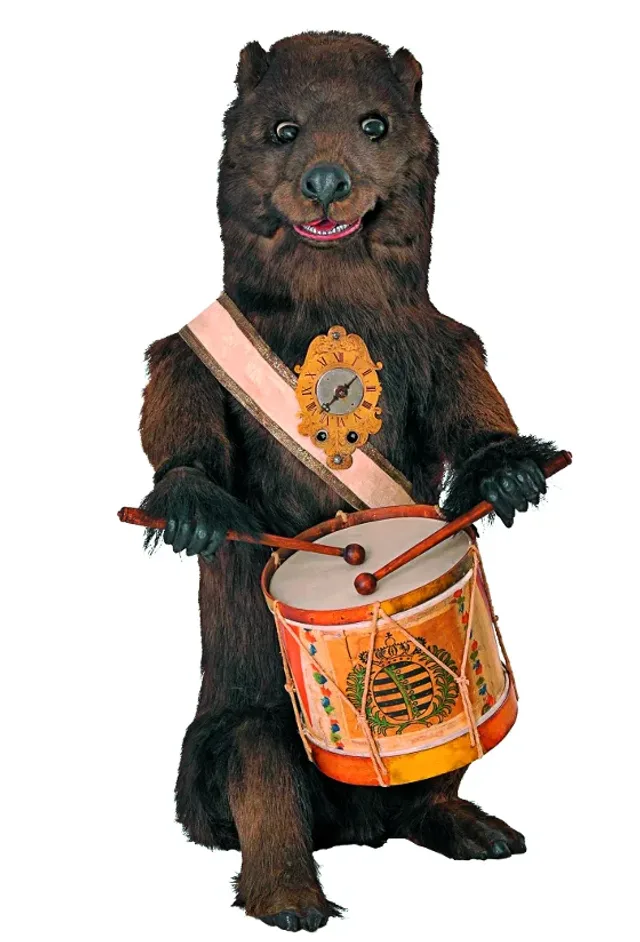
A bear automaton cum clock sounds its alarm by beating its drum.
PR
- Another time-telling automaton, this one a turban-wearing pasha on a horse. His eyes move once a second and, every hour, he raises his scepter and his head moves. The automaton was made in Germany around 1630.
- A clock, inspired by church tower clocks, made in 1587 by the Nuremberg clockmaker Paulus Schuster and given as a gift to Christian I, Elector of Saxony, by his wife Sophie. The clock, 30 inches high, has eight movements driving its various functions, which include an alarm and an annual calendar.
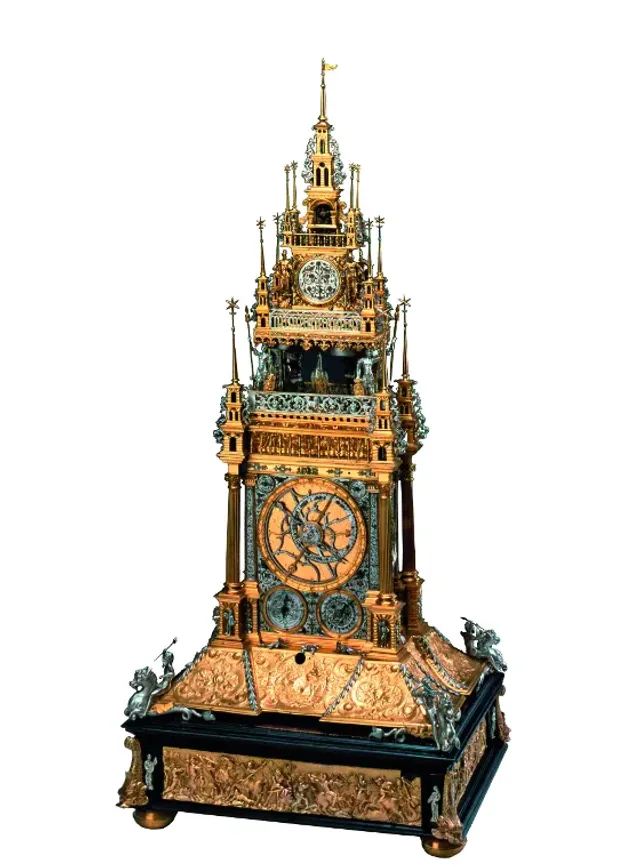
A clock from 1587, modeled on a church tower clock and containing eight movements
PR
As many watch fans know, watchmaking in Dresden begat watchmaking in Glashütte. Tiny, tucked away in the Ore mountains, with no history of skilled handicrafts, Glashütte was an unlikely candidate for a watchmaking center. How it became one is explained in a section of the museum called “From Dresden to Glashütte,” which includes 19 watches and clocks by German watchmakers Johann Köhler, Heinrich Seyffert, Johann Schumann, Johann Gutkaes, and Adolph Lange (founder in 1845 of A. Lange & Söhne), with written explanations and discussion on the museum’s audio guide. Lange & Söhne fans will be interested to see a replica of the well-known digital clock that Gutkaes, under whom Adolph Lange apprenticed, made for the interior of Dresden’s Semper Opera house. The clock gives the time in five-minute intervals rather than by the minute, using numerals instead of a standard dial because of limited space on the opera-house wall. The clock’s display served as a model for the big-date displays that the modern A. Lange & Söhne puts on its dials.
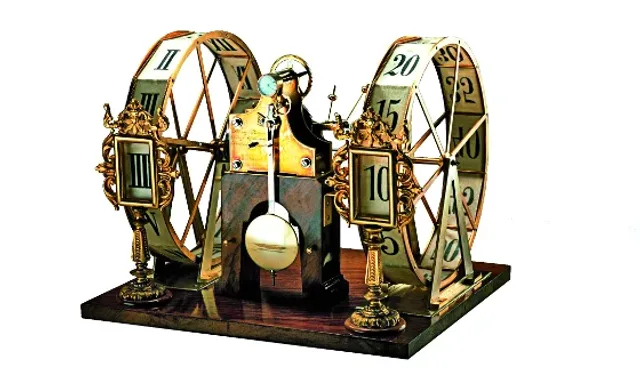
A replica of the five minute digital clock in Dresden’s Semper Opera House
PR
They can also see the A. Lange & Söhne pocketwatch 42500, the most complicated watch ever to bear the brand’s name. It is one of four watches from the original A. Lange & Söhne company on display. (The modern-day A. Lange & Söhne was founded in 1990. The original company had been nationalized after World War II and the brand name had disappeared.) The watch, completed in 1902, is a grande complication, with perpetual calendar, split-seconds chronograph, minute repeater, and petite and grande sonneries. The movement may have been made by Audemars Piguet and embellished by Lange (the initials of Jules Audemars and Edward Piguet appear on the gong block). A. Lange & Söhne restored the watch from a ruinous condition a decade ago.
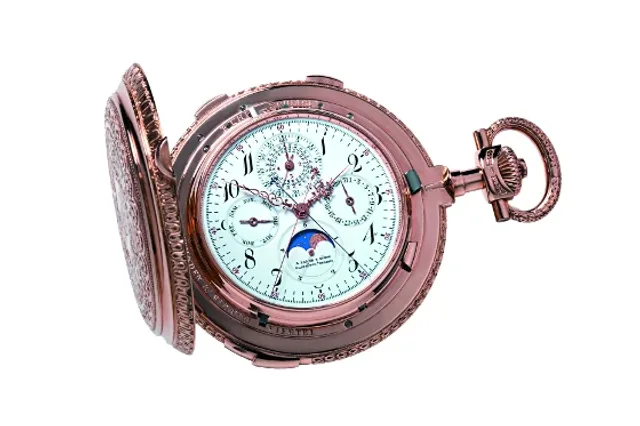
A. Lange & Söhne’s pocketwatch 42500, a grand complication completed in 1902
PR
At the press conference announcing the museum’s reopening, Schmid explained that his company’s interest in the museum is deeper than geographical proximity. “This museum was the cradle of [Saxon] watchmaking,” he said. “Without this museum, there wouldn't be watchmaking in Glashütte.” That’s because it was a repository not just of instruments but of instrument-making knowledge, including, most importantly, timepiece-making knowledge. It gave rise to the watchmaking industry that shot up in Glashütte in the mid-19th century. The salon was the go-to place in Saxony for anyone who wanted to make a name for himself making measuring or observation instruments, whether for meteorological and astronomical phenomena, distances, or, of course, time. At the salon, visitors could see and learn from the very best instruments made to date. The salon employed the brightest lights in Saxony to choose, care for, and explain to others the myriad treasures in the collection. Many were watch- or clockmakers themselves, who continued to make precision timepieces during their tenures at the salon.
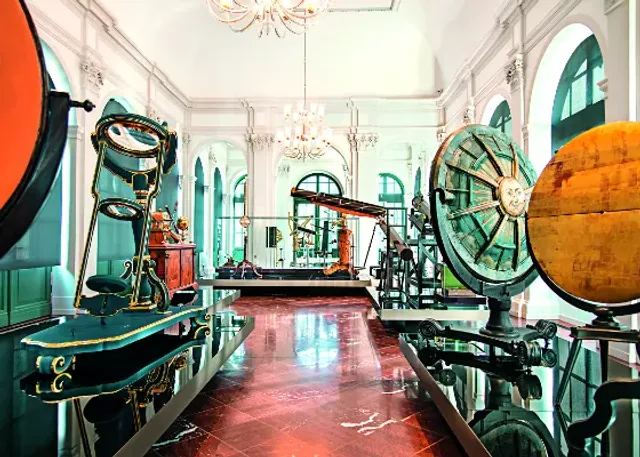
including burning mirrors, magnifying glasses and telescopes.
PR
These men included several who might be called the grandfathers of the Glashütte industry: Schumann (who was literally the grandfather of Adolph Lange), Seyffert, Gutkaes, and Wilhelm Gotthelf Lohrmann. All of them taught or otherwise influenced Glashütte watchmaking’s founding fathers: Adolph Lange, most famously, but also Carl Moritz Grossmann, Adolph Schneider (Lange’s brother-in-law, who helped him set up his company when he first came to Glashütte), and others.
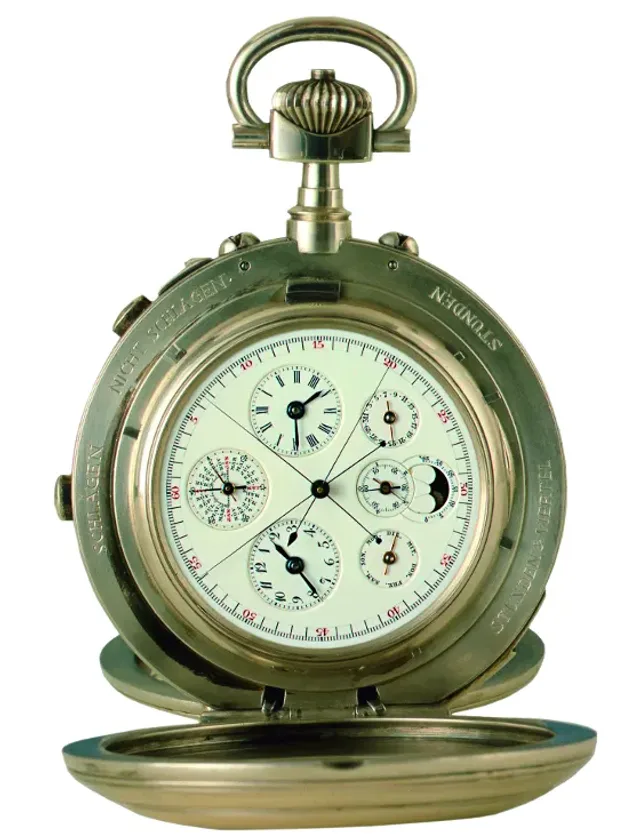
The highly complicated, silver-cased La Grandiose, made in Germany between 1942 and 1952, contains a movement made a half-century earlier by Louis Piguet.
PR
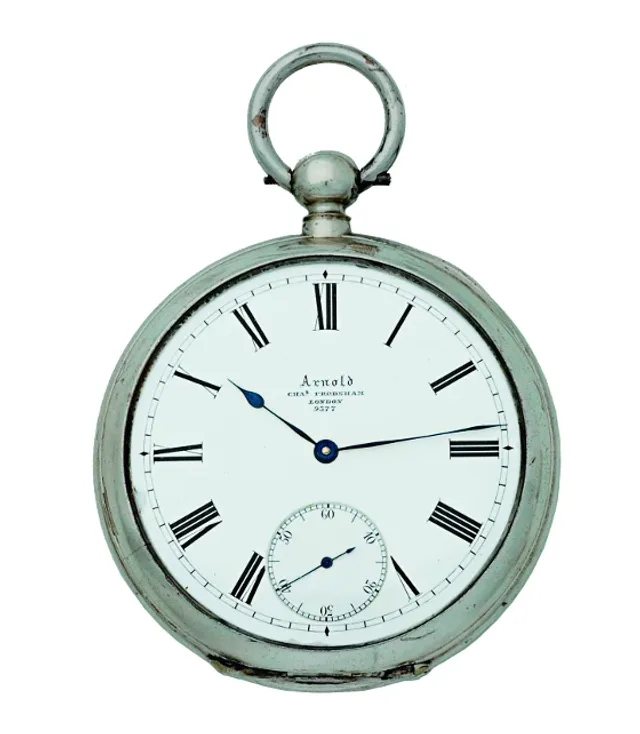
This pocketwatch from the English watchmaker Charles Frodsham is one of 108 watches in the museum.
PR
The salon played another vital role in Saxony’s horological well-being: between 1783 and the 1920s, it provided a time service. In the beginning, the service depended on observations of the sun made using a hole in a window shade (it was noon when the sun’s rays crossed the meridian line drawn on the floor). As the decades passed, the service’s time-measuring methods became increasingly sophisticated. All of Saxony depended on the service, which earned the nickname “the Greenwich of Saxony.” The salon hence gave the watchmakers of Glashütte their most valuable tool: the correct time.
This article first appeared in WatchTime's August 2013 issue and has since been updated with new information.