The Good Old Days: A Spotlight on Five Vintage Watches
A watch list
Photography by Djaccomo Boom.
While the current collections of all the watch brands combined already result in a massive number of different models, you can really get lost in exploring the past. For this photoshoot, we explored the good old days in style, highlighting five very different (vintage) watches that each represents an era in its own way. Carefully enjoyed by past owners, they all currently reside in private collections but were brought together especially for this shoot.
Rolex Day-Date Ref. 1803
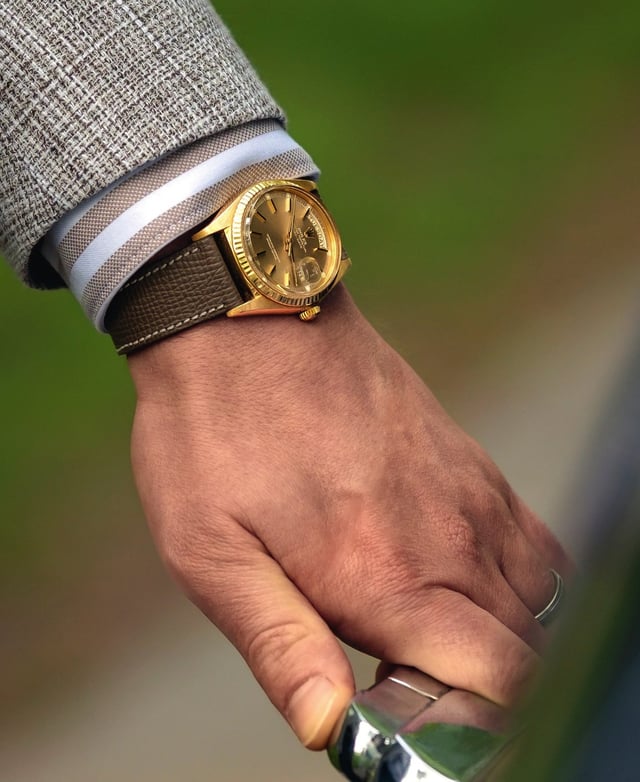
The most noticeable thing that sets the Rolex Day-Date Ref. 1803 apart from its more modern siblings is the pie-pan dial. While not as extreme as with certain vintage Omega Constellations, it still adds a nice bit of depth to the dial. This particular Day-Date from 1976 is made from yellow gold but has quite a warm glow to it, indicating that the copper content of the alloy was slightly higher in those days. The dial is also quite unique, as it is a so-called "ghost dial." This refers to the fact that the printing is in white, but on a relatively light-colored dial, in this case a kind of tan-brown. This makes it so that under certain angles, the writing cannot be seen, hence the term "ghost dial." Powered by Caliber 1556, this Day-Date has no quick-set function for either the day or the date and is often surpassed by collectors in favor of more modern siblings that do offer this feature. While understandable, it is also part of the charm of a watch like this, pretty much the same as that the Aston Martin DB2/4 Mark III lacks power steering.
Piaget 12P "Clous de Paris"
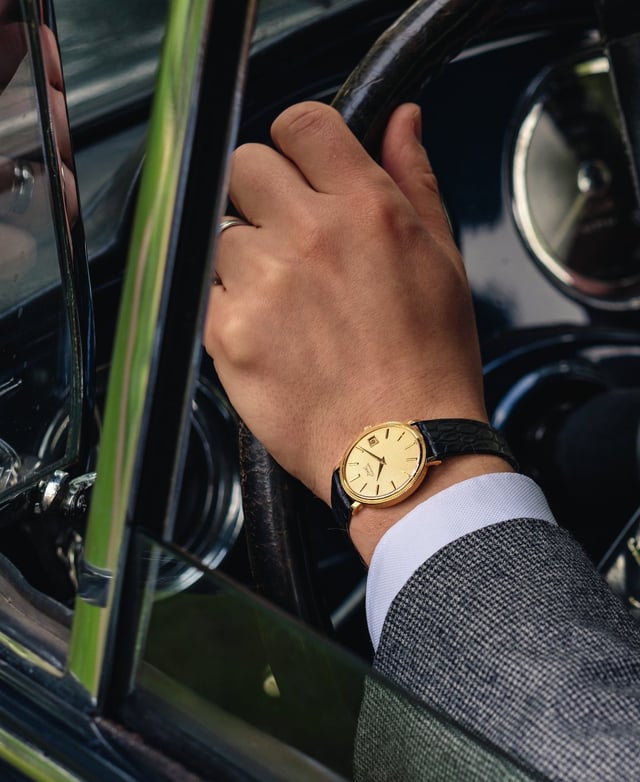
In 1960, Piaget stunned the world with the introduction of Caliber 12P. This automatic movement measured a height of just 2.3 mm, making it the thinnest automatic movement at the time. To achieve this, Piaget took the lessons learned from their equally groundbreaking manual-wind Caliber 9P, which they launched three years earlier in 1957 and was 2 mm thin. Powered by a 24-karat gold micro-rotor, the slim profile of Caliber 12P offered the designers of Piaget a great deal of freedom, precisely the reason it was created in the first place. This example features a classic style yet is full of surprising details. The case, bezel and even the dial are decorated with Clous de Paris, the official term for this hobnail pattern. The hands seem to be almost glued to the dial, so close are they placed to it. As Piaget would like to keep the overall profile of the watch as slim as possible, the hour markers are not regular bar-shaped, but pressed down under an angle. This way, they give the optical illusion of space that isn't there with this ultra-slim Piaget.
IWC Da Vinci Perpetual Calendar Rattrapante
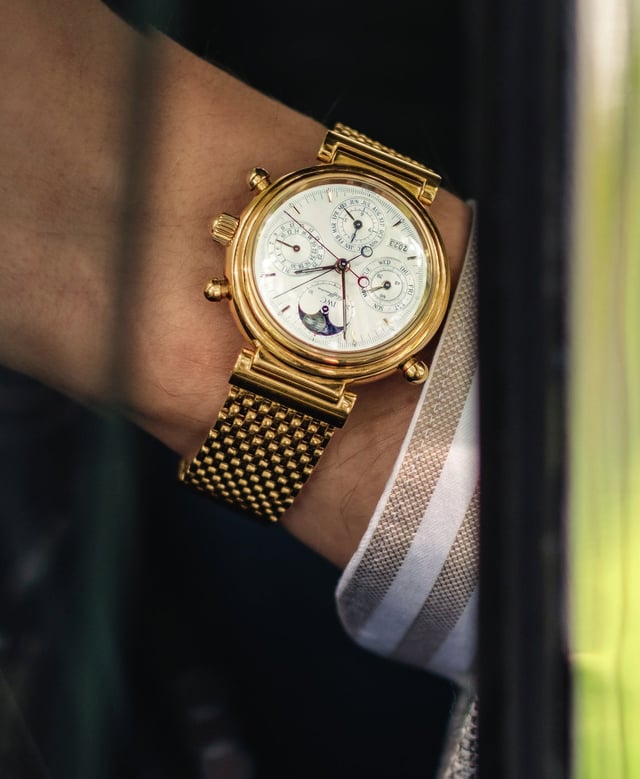
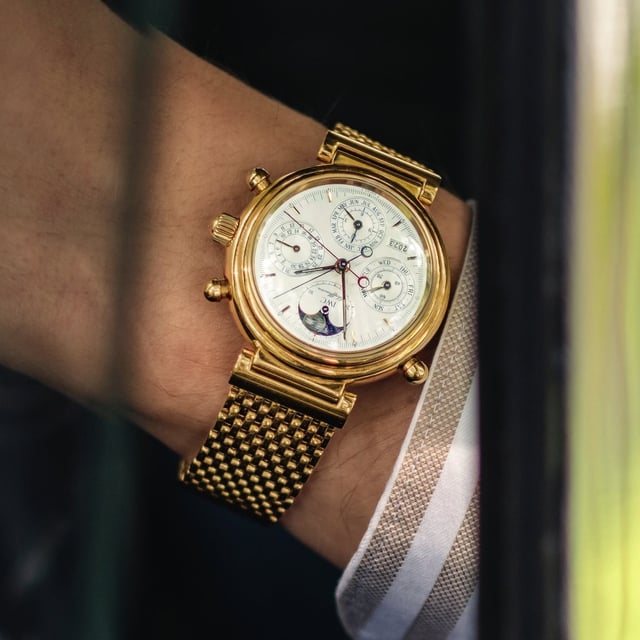
In 1985, IWC launched the Da Vinci Perpetual Calendar Chronograph, officially leaving the quartz crisis behind. Developed by legendary technical director Kurt Klaus, this Da Vinci was taking a different approach to a classic complication. Klaus used the trusted Valjoux 7750 automatic chronograph caliber and added a perpetual calendar module to it, combining two very desirable complications. Klaus did away with the need for correctors on the side of the case, and made the perpetual calendar very easy to set, with just the crown. It lacks a leap year indicator, but instead shows the full year in a window just below 8 o'clock. In 1995, IWC celebrated the Da Vinci Perpetual Calendar Chronograph 10th anniversary by adding its tenth hand, turning the chronograph into a rattrapante, or split-second chronograph. This complication was developed by another great name in watchmaking, Richard Habring, who worked at IWC, together with Klaus. With its hooded lugs and exceptional combination of complications, the IWC Da Vinci Perpetual Calendar Rattrapante is even today still a powerhouse.
LeCoultre Galaxy
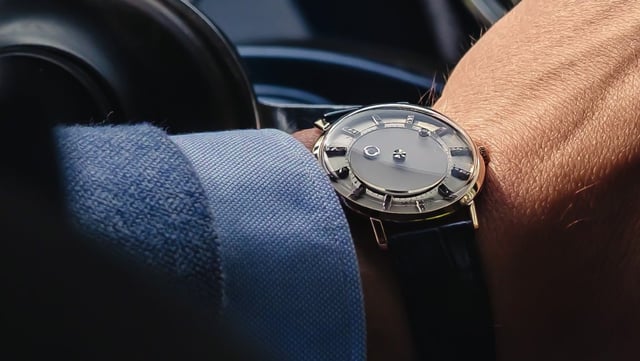
Sometimes the stars align to create something magical, and the LeCoultre Galaxy is just that. Right after World War II, the economy of the United States was experiencing rapid growth, resulting in a robust demand for luxury timepieces. Mystery watches came into fashion, and the LeCoultre Galaxy was one of the finest to have. The "mystery" part comes from the lack of hands. Instead, two diamonds tell the time. One is set in white gold on the rotating center part of the dial, while a diamond in a smaller setting hovers over it, mounted in a disk made of transparent hesalite. The hour markers are set with brilliant-cut diamonds as well, leaving no mystery (pun intended) about why this LeCoultre is named Galaxy. Marketed as a men's watch back in the day, it can still easily play this role as the fun-effect of the mystery dial, and the relatively understated use of diamonds, ooze a certain timeless elegance.
Omega Ref. 2420 "Tiffany & Co."
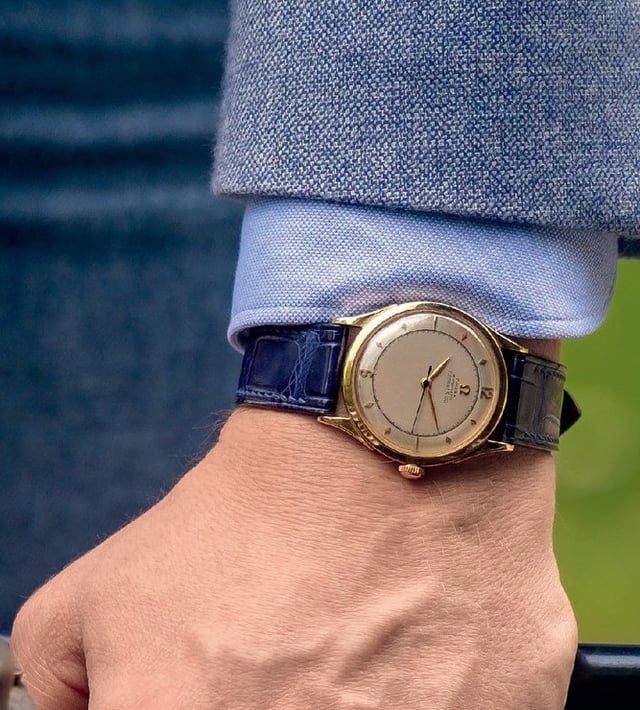
This Omega Ref. 2420 is not only a great example of an early bumper automatic by the brand, but it also had the good fortune of being sold by Tiffany & Co. Written in a slender font, it is one of those rare examples that two of these famous names combined grace a dial. While a mere 33 mm in diameter, the Omega has plenty of character to attract attention. The 14-karat gold case is fitted with beautifully shaped lugs, while on the dial, the shape of the hour markers impresses. A blue minute track adds a dash of color, corresponding with the blued seconds hand. Vintage watches often offer a different experience compared to their modern siblings. With this Omega Ref. 2420, it is the motion of the bumper automatic of Caliber 28.10 that reminds you that you are wearing something special. In a bumper automatic, the oscillating weight doesn’t make a full rotation but bounces the rotor from one side to the other, where it hits a small spring, taking advantage of the motion of your wrist. While rather subtle, you can on occasion, feel this when wearing a bumper automatic, adding an extra dimension of owning one.
Aston Martin DB2/4 Mark III

The backdrop for these five watches is what is perhaps currently the most underrated Aston Martin, the DB2/4 Mark III. It was sold between 1957 and 1959, and as its name already indicates, it was an evolution of the DB 2/4 Mark Il model that it succeeded. It was the very first Aston Martin that featured the now-iconic shape of the front grille. The lines of the Aston Martin DB2/4 Mark Ill are elegant yet powerful, something that is also matched by performance. It is powered by a 2.9-Liter Lagonda straight-6 engine, which W.O. Bentley originally designed. Producing 162 hp in its standard trim, it made the Aston Martin DB2/4 Mark III a true Gran Turismo. When you look at the front fender, you also see where Aston Martin got their ideas for the DB11 from. Long before the DB5 was known as the car of James Bond, lan Fleming opted for this Aston Martin DB2/4 Mark Ill as the mode of transportation for the world's most famous secret agent in his novel, Goldfinger. Aston Martin made approximately 551 DB2/4 Mark Ills, of which this is one of the only 60 that have the steering wheel on the left side of the car.
This article was originally published in the July/Aug 2023 print issue. To subscribe to the magazine, click here.