Jaeger-LeCoultre announced its all-new Geophysic collection this week. We put these watches' predecessor, the limited-edition Geophysic 1958, to the test in this feature story from WatchTime's July-August 2015 issue. All original photos are by OK-Photography.
In the 1950s, a group of the world’s top scientists got together to lay the groundwork for what became known as the International Geophysical Year, which began in mid-1957 and lasted through 1958. Activities by the 67 participating countries included expeditions to the Antarctic, satellite launches and the establishment of global databanks that are still used today. The goal was to promote scientific research and interchange between countries, particularly between the East and West.
Jaeger-LeCoultre marked the year by launching the Geophysic 1958, designed for scientists, engineers and others in technical professions. The watch was equipped with antimagnetic protection, luminous hands, a chronometer-certified hand-wound movement and water resistance.
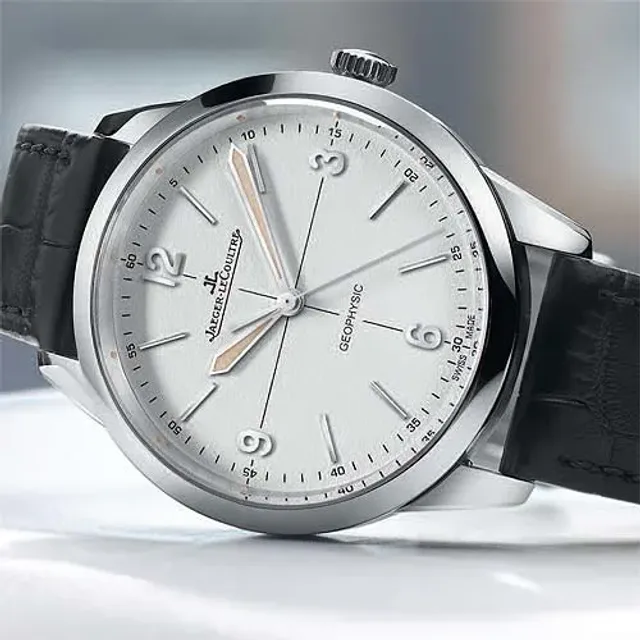
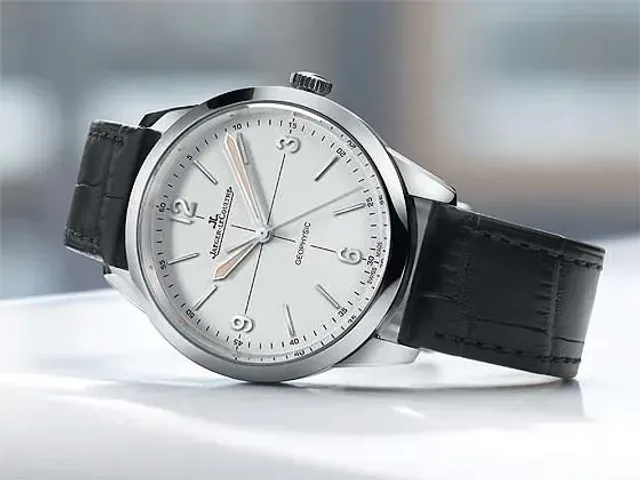
The Geophysic was technically advanced and very precise, but it was the watch’s elegant design and limited production (1,000 pieces) that clinched it as a collectors’ favorite. In 2014, Jaeger-LeCoultre created another limited-edition model of the same name, the Geophysic 1958, as an homage to the original. The new watch closely follows the design of its predecessor. The shape of the case, with its sloping bezel and straight lugs, recall the original model. The dial looks very similar, too, with its long hour and minutes markers, cross hairs and dagger-shaped hands. The steel version we tested has numerals at 12, 3, 6 and 9, as did one version of the original dial. (There was another, more famous, Geophysic dial with just two numerals. The company chose this dial for the platinum variation of the new watch.) The dial has a harmonious feel, even though the large hands may not be to everyone’s taste with their orange “vintage-look” luminous paint.
The dial is easy to read, but the luminous dots at the hour markers are rather small for nighttime legibility. Previously these dots were placed on the underside of the Plexiglas crystal, but they are now on the inner bezel edge. The textured surface on the dial is the same as on the original. The crown also looks similar to its predecessor: a slightly rounded, logo-free polished dome rarely seen these days. Some modern updates include the sapphire crystal and a larger case – 38.5 mm compared to 35 mm. The mid-section of the case has a carefully brushed finish, which covers every surface but the tight corners between the lugs.
The movement is not on display, and for good reason – an inner soft-iron case protects it from magnetic interference, just as it did on the original. Then as now, the shield provided pro- tection not just in highly magnetic environments like those an engineer might encounter, but also in everyday settings. The caseback is decorated with Jaeger-LeCoultre’s initials over an engraved emblem symbolizing the International Geophysical Year – a globe with lines of latitude and longitude. The caseback notes that the watch is a limited edition of 800 pieces (which are not individually numbered) and that it is water resistant to 100 meters. The alligator strap is nicely finished. It has a varnished top layer and an even, machine-sewn seam. It is lined with bison leather, which does not readily show signs of perspiration or wear and feels smooth against the skin.
Click here to download our full test of the Jaeger-LeCoultre Geophysic 1958, including complete specs, scores and prices, for just $2.99 from the WatchTime online store.
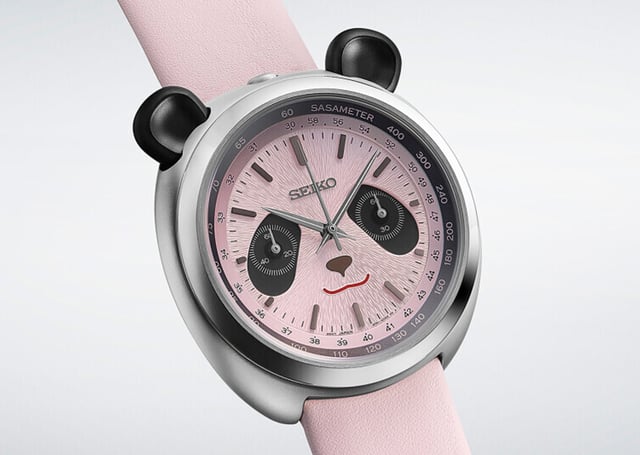
Seiko’s Power Design Project Collection 2 gives the panda-themed chronograph a playful makeover, with two limited editions featuring white or pink dials and an abundance of carefully considered details.
Bulova revives its historic A-11 military watch with a 37mm automatic model created in connection with the upcoming movie Jimmy about actor and WWII pilot Jimmy Stewart.
From Citizen and Longines to Tudor, Omega, and Vacheron Constantin, these seven traveler-GMT watches offer compelling alternatives to the Rolex GMT-Master II.
The Rolex Daytona is one of the world’s most desirable sports chronographs, but compelling alternatives from Omega, Zenith, Breitling, and others offer plenty of competition.
From the 1894 Omega caliber and the first Seamaster to the Moonwatch, Co-Axial escapement, Master Chronometer, and Ultra Deep, these are 14 defining Omega milestones.