Nov 5, 2013
Reading time 3 min.
Watch Review: IWC Da Vinci Perpetual Calendar Digital Date-Month
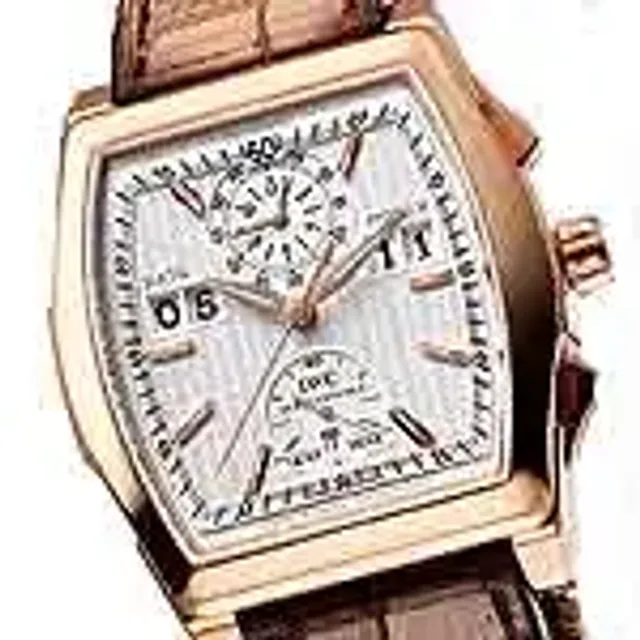
Two weeks ago, we presented a review of Omega's DeVille Hour Vision Annual Calendar watch. This week, as we get closer to the time of year for purchasing a new calendar, we present another review of a calendar watch from WatchTime’s December 2010 issue — the IWC Da Vinci Perpetual Calendar Digital Date-Month, with original photos by Nik Schölzel.
The perpetual calendar is more complex than an annual calendar, or the rarer four-year calendar, because it shows February 29 in leap years. It is usually accomplished using a 48-month wheel, or a 12-month wheel with a satellite. In the Da Vinci Perpetual Calendar Digital Date-Month, IWC combines its calendar with a chronograph. When IWC first combined these two complications in its Da Vinci in 1985, it was viewed as an extraordinary feat. A quarter-century later, with complications abounding, IWC is offering some special extras: the chronograph is a flyback and shows elapsed hours and minutes in a single subdial.
The perpetual calendar (like the time) is easy to read: the date and month are shown in two large apertures on the left and right sides of the dial, respectively. Each of these displays uses two disks, one for each of the outsized digits. It takes about 20 minutes for both displays to advance completely. At the end of February, when four days must be bridged, the process begins earlier and is complete after two hours, shortly after midnight. The running seconds subdial and a window for the leap-year display are at 6 o’clock.
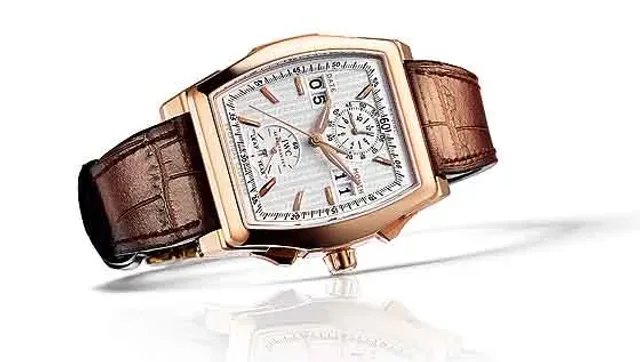
IWC Da Vinci Perpetual Calendar Digital Date-Month - front
PR
The perpetual calendar is fully programmed at IWC. If you need to reset it, you do so using the crown alone. To move the date forward, you pull the crown out to its first position and turn it clockwise. At the end of the month, you must also advance the month. In doing so, you must be careful not to turn the crown too far, because then you will have to either advance the months through the entire four-year cycle to return to the correct month, or allow the incorrect numeral to remain in place for the duration of the month. While the chronograph pushers operate smoothly, the crown is more difficult to handle. It is screwed down despite the case’s relatively low water-resistance of 30 meters.
The Da Vinci is an elegant and impressive watch. The hefty, complex gold case and elaborate dial contribute to the price of $44,300.* And although the strap might have benefited from a bit more attention to detail, it allows this large watch to lie quite comfortably on the wrist.
The caseback window reveals the shock-absorbing rotor bridge of this manufacture movement. The chronograph works with a column wheel and rocking pinion. Fine regulation is accomplished with regulating screws on the balance. IWC decorates the movement with circular finishes and perlage but leaves the edges untouched.
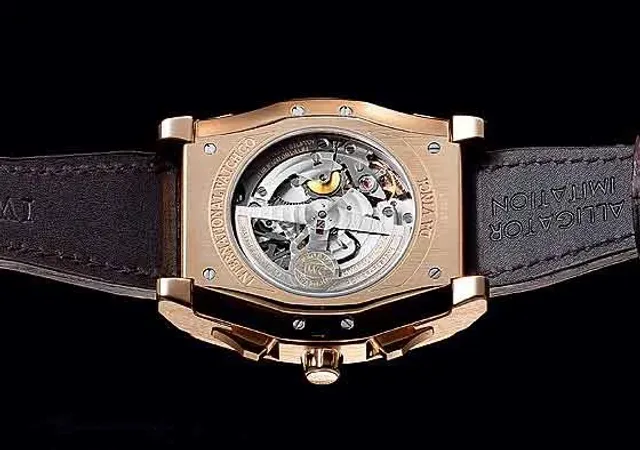
IWC Da Vinci Perpetual Calendar Digital Date-Month - back
PR
SPECS:
Functions: Hours, minutes, seconds; flyback chronograph with counters for minutes and hours; perpetual calendar with large date, large month and leap-year display
Movement: Cal. 89800, automatic; 28,800 vph; fine regulating system with balance weights; power reserve = 68 hours
Case: Rose gold, sapphire crystal with nonreflective coating on both sides, eight screws fastening the caseback with sapphire window; water-resistant to 30 meters
Price: $44,300*
(*Prices are circa December 2010 and are subject to change.)