

Two chronographs with in-house movements — Breitling’s pilot-styled Chronomat B01 and IWC’s rugged Big Ingenieur Chronograph, designed for earthbound adventure — go head-to-head in this comparison test, with photos by Nik Schölzel.
A watch with an in-house chronograph movement is something quite special. Even many well-established brands do not offer their own factory-built movement with a stopwatch function. One notable exception is Patek Philippe, which developed one for its collection only recently. It’s no wonder such movements are so rare: a chronograph is a huge complication whose implementation requires enormous care and attention. The existence of cheaper chronographs is explained by the wide distribution of simpler movements that have been built for decades, like the Valjoux 7750 from ETA.
For the longest time sports-watch brands like IWC and Breitling didn’t produce their own chronograph movements, either. But things have recently changed at these two companies: at the 2009 Baselworld watch fair, Breitling introduced its long anticipated in-house movement, the B01, and the first and only watch model to contain this movement, fittingly named the Chronomat B01. IWC presented its Big Ingenieur Chronograph at Geneva’s SIHH watch fair in early 2009, with an in-house movement that debuted in 2007 in the company’s Da Vinci chronograph. (Click on watch photos for wallpaper images.)
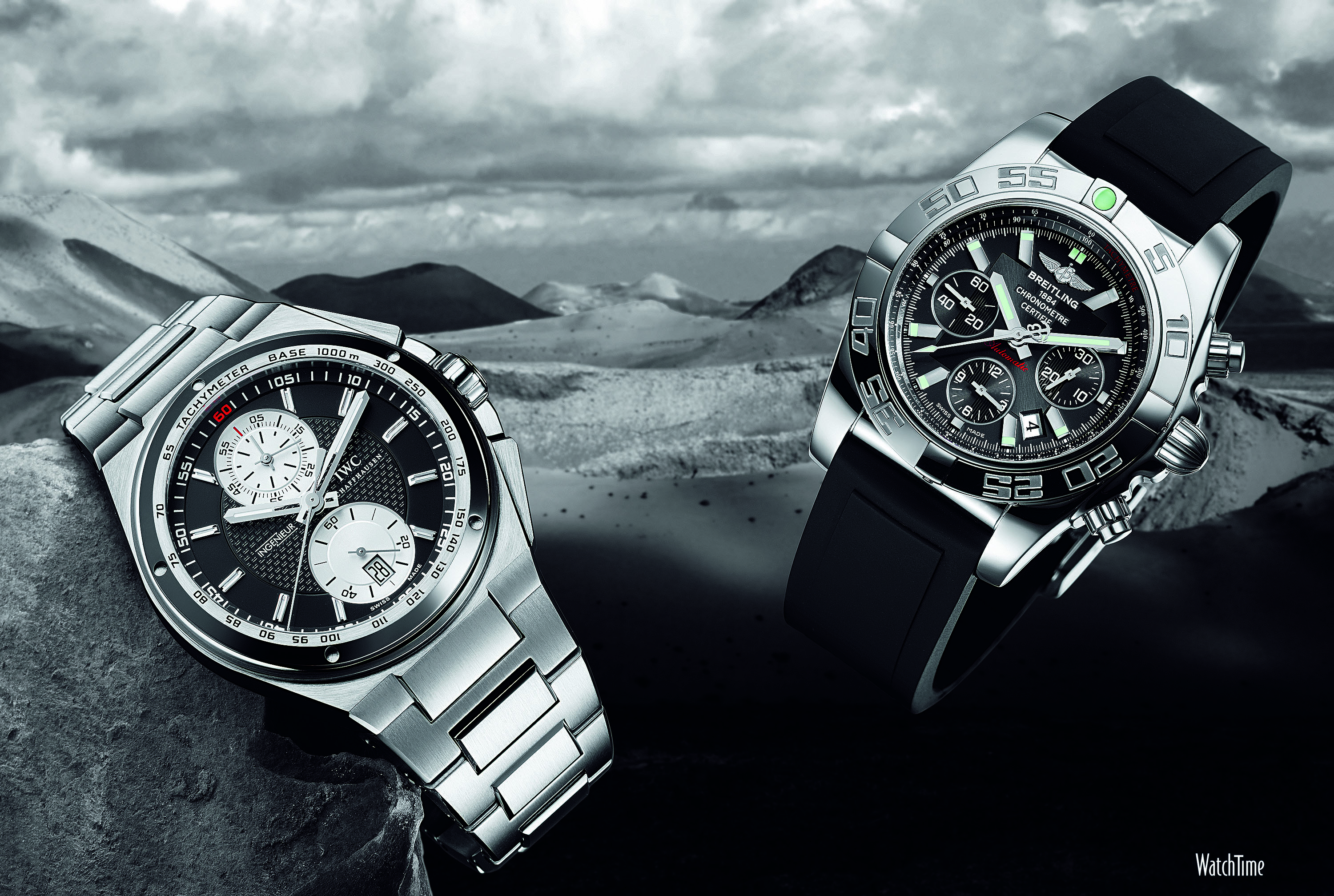
The Chronomat B01 faithfully follows the Breitling pilot-watch tradition. Its contemporary design includes functional details like a rotating bezel as well as other design elements that are purely decorative. An extreme attention to detail is evident on the dial, whose central element is a square with its edges defined by the center points of the three subdials. The ridged patterns in the subdials change according to which half falls within this square area: outside the square, the pattern is radiating circles; inside, it is vertical ridges. The hour-counter subdial at 6 o’clock is divided into quarters. The hands on the subdials incorporate the square shape, and the quarter-hour markers on the bezel are also square. Even the angular typography of the numerals on the subdials and bezel (with its square “zero”) reinforce this bold style. The three different numeral fonts add interest, but in this case, more restraint would have made a stronger overall statement, and the font style of the numerals on the bezel takes some getting used to. Generally speaking, though, we liked the design of the Chronomat B01 very much.
The IWC watch makes an even sturdier overall impression due to its larger diameter. All the numerals are executed in the same type found on other Ingenieur models. The standout features of the Big Ingenieur Chronograph’s dial are the subdials located at the top and bottom, with a silver ridged structure that sets them off from the rest of the black main dial. A geometric pattern fills the inner section of the dial. Luminous coating is applied deep within the grooves of the silver-colored markers, whose shape reflects the elongated hour and minute hands. The Ingenieur case has rectangular pushers that are neatly integrated with the crown guard and bezel.
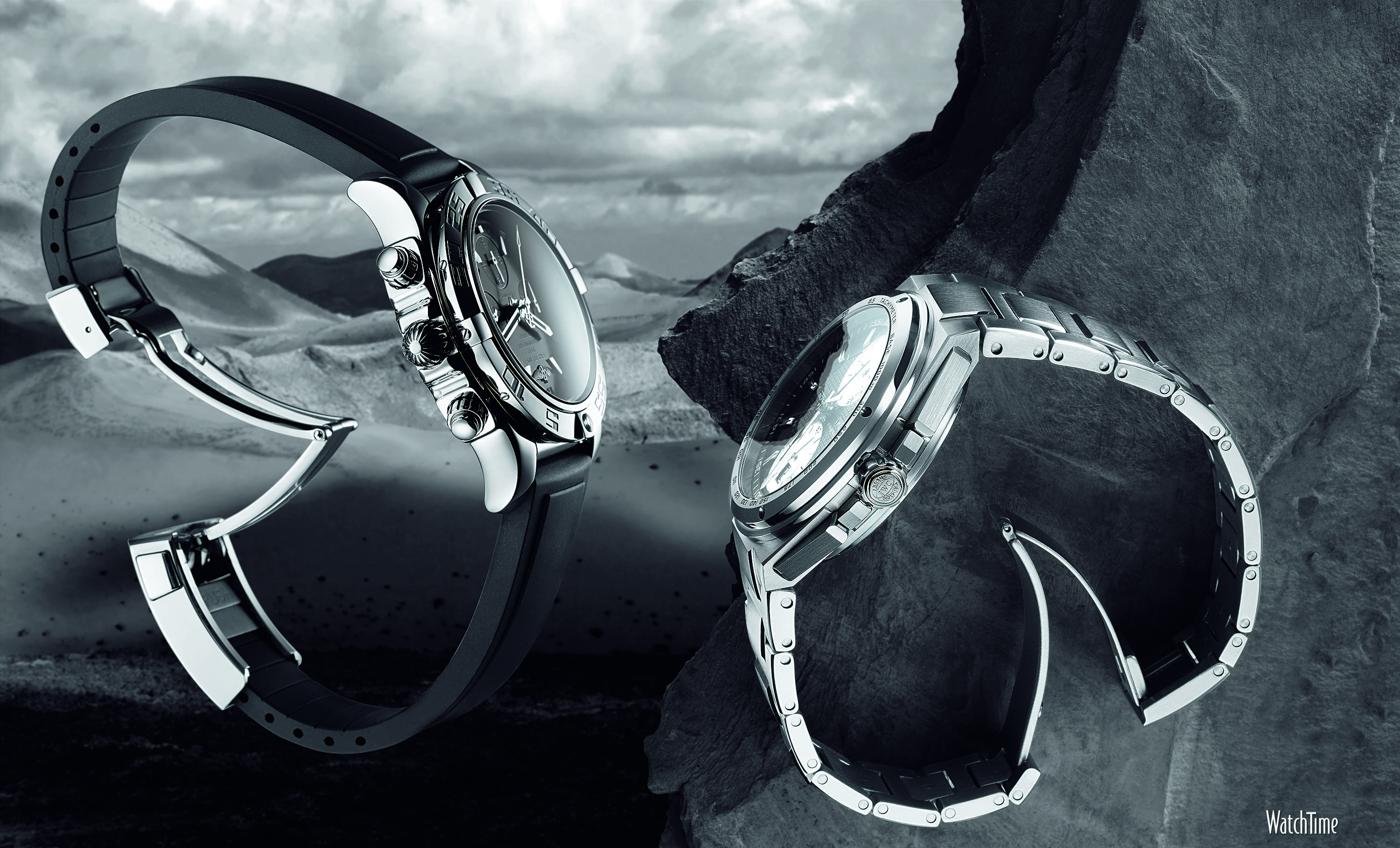
The Big Ingenieur is only available with a single dial type and in two case materials (steel or rose gold). The Chronomat B01 is available with a wide range of different dials, with markers or Roman numerals, in steel or gold (or various combinations), and with a number of different straps and bracelets.
The time and date are easy to read on the black dial of the Breitling watch. However, it’s a bit difficult to read the elapsed minutes and hours on the small subdials with their silver hands. The IWC chalks up double the points in this category. First of all, and rather surprisingly, here the silver hands provide terrific contrast with the silver subdials. Also, the elapsed minutes and hours are cleverly combined on the top subdial with easy-to-read 12-hour and 60-minute divisions, as in a second-time-zone display. The effect is more striking over longer timed periods than shorter ones, and numerals on the hour track would have been helpful. But the sheer size of the dial aids in legibility.
The other side of the coin? The Big Ingenieur’s 45.5-mm case needs the width of a large wrist as a counterbalance. The watch overwhelms a normal wrist and doesn’t fit snugly. On a steel bracelet, it feels top-heavy and so must be worn tightly to keep it from sliding around. In contrast, the Chronomat B01 does not appear overly large despite its diameter of 43.5 mm, and it’s also more comfortable to wear. It lies snugly against the wrist, thanks in part to the supple rubber strap and adjustable strap extension integrated into the clasp. The Breitling clasp has a two-button deployment system that is attractive, easy to use and nicely finished. The rubber strap appears quite plain in comparison; luckily, the Chronomat also comes with a crocodile or calfskin strap or a metal bracelet.
The Big Ingenieur Chronograph is also available with a crocodile strap or a stainless-steel bracelet. The bracelet can be adjusted without a screwdriver, and the single-button deployant clasp is surprisingly flat. However, the two hinged parts of the clasp are made of thin metal and shouldn’t be subjected to excess pressure when open. Both bracelet and clasp boast superb finishing: the bracelet’s carefully beveled and polished edges highlight the line finish on all other surfaces, perfectly matching the extraordinarily fine finishing on the watch case.
The Big Ingenieur’s two large pushers are easy to use. The screw-down crown is also large enough to easily grasp and turn. The hack mechanism and quick date adjustment simplify the accurate setting of the time and date.

Breitling’s watch also includes both of these useful features. In contrast to the Valjoux 7750, these two manufacture movements allow the date to be changed right before 12 o’clock without running the risk of damaging the movement. The fluted crown on the Chronomat is easy to grasp and turn, and the pushers are also screwed. Although this makes using the chronograph function somewhat more awkward, it does provide greater protection for the pushers and increases the water-resistance of the watch to 500 meters. Unfortunately, you’ll have to press the button rather firmly to start the chronograph, due to the design of the chronograph levers. The Chronomat’s unidirectional rotating bezel has 240 ratchets and turns smoothly but should be easier to grasp.
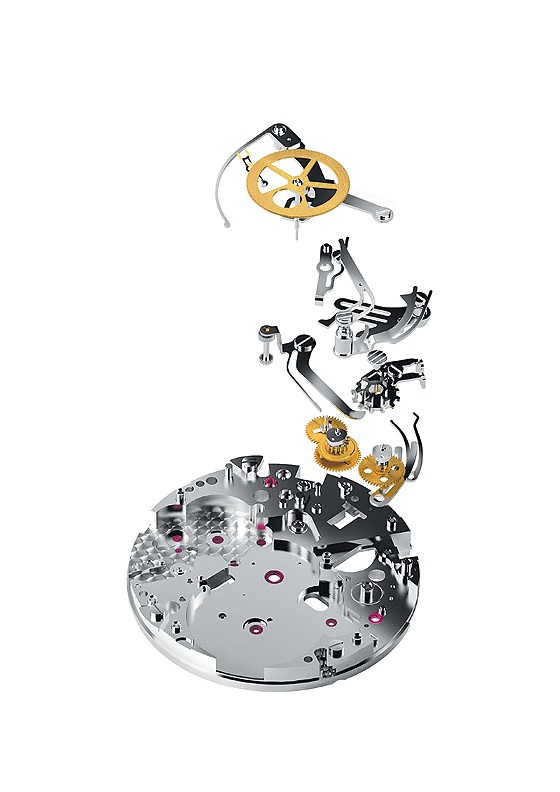
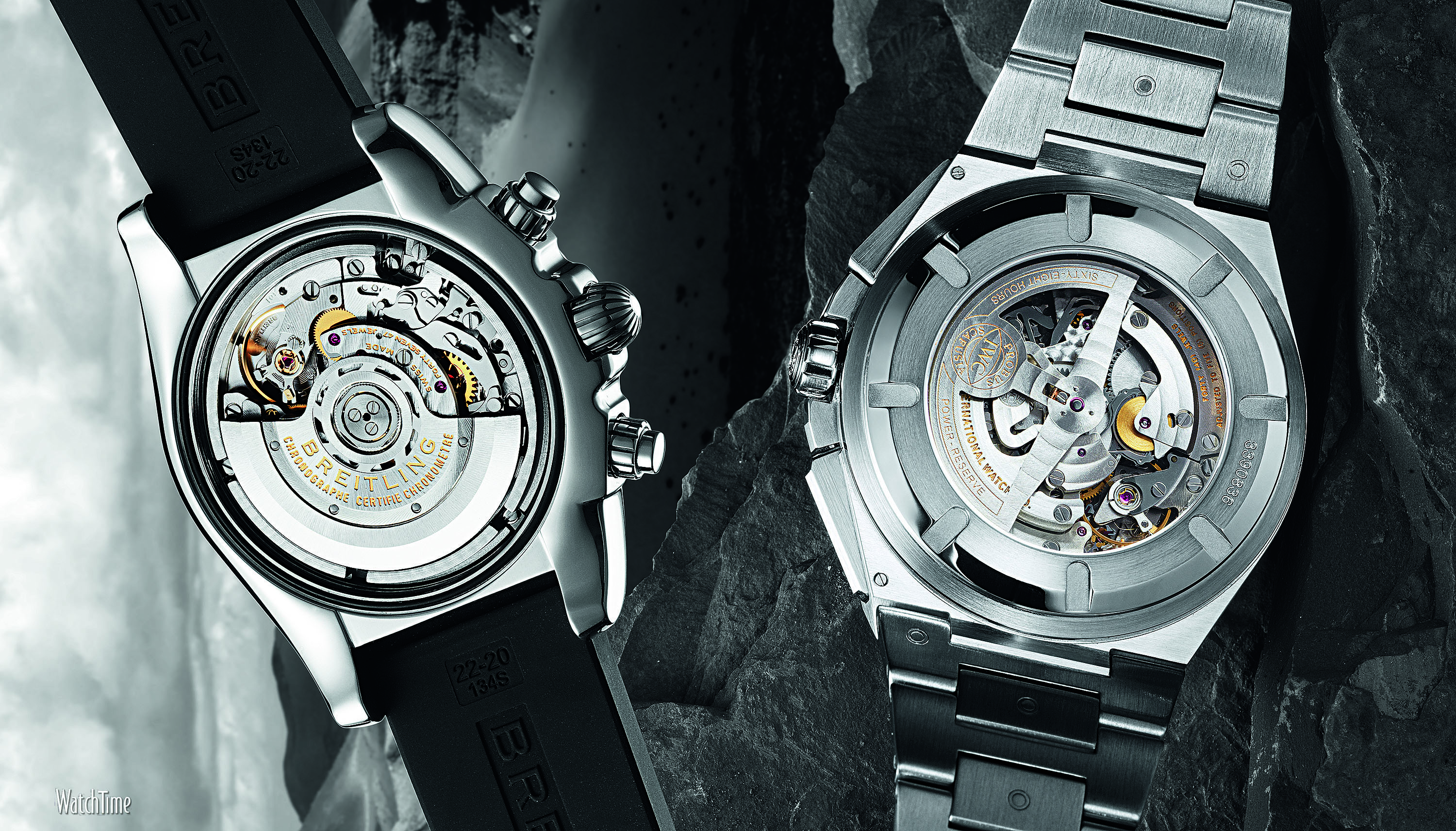
Interestingly, the dimensions of the two movements vary only slightly. Each has an impressively long power reserve of more than three days. Plus, both movements are equipped with a bidirectional winding system and have an elegant column-wheel mechanism. But if you examine the movements (and you’ll have to remove the caseback from the Breitling to do this) the differences are immediately clear. While IWC uses the same automatic shock-protection rotor bridge as in its Ingenieur movement 80111, the Breitling appears somewhat more conventional. Breitling wins points with a patented self-centering system for the zero position resetting hammers, a calendar with an instantly advancing date, and especially for the modern vertical clutch that prevents the chronograph seconds hand from jumping when it starts. Breitling added a shock-absorbing escape wheel to make the watch more resistant to impacts. Another bonus: the movement includes an index-assembly that allows the wearer to quickly and easily adjust the watch’s rate to his or her preferred speed. Breitling also produces its mainplates and bridges in-house, and sets its own jewels as well.
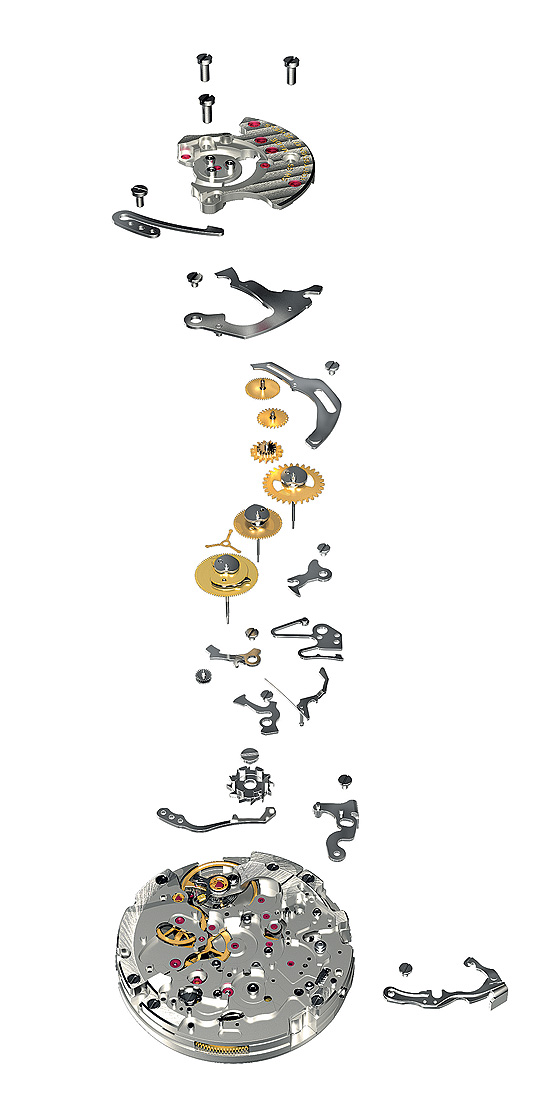
For the 89360 caliber, IWC developed a new double-pawl winding system based on its standard Pellaton winding system. With two double-pawl winders, it doubles the number of pawls that push and pull to wind the mainspring. They are no longer controlled with a cam but by a crank similar to the type used in automobiles. The pawls are arranged to apply winding torque even at the slightest motion of the rotor. This winding system is said to be 30 percent more efficient than its predecessor, making it possible to reduce the weight of the rotor and thereby reduce wear. The movement features a free-sprung oscillating system, a sign of high quality. Plus, the flyback function in the Big Ingenieur Chronograph (not featured in the name of the model, as is usually the case) requires a great deal of time and effort in the design stage. The minute counter does not jump, but advances slowly. Unfortunately, the date disk moves slowly, too, and begins visibly advancing at 11 o’clock.
The two movements are similar in their degree of decoration, with various finishes, perlage on the mainplate and polished screw heads. The cutouts on the IWC rotor provide a nice view of the movement, but few edges show beveling or polishing. Like the Valjoux 7750, IWC’s movement uses a rocking pinion for its chronograph clutch. This solution was developed in order to simplify the chronograph but has proven to be essential. The axis of the pinion is moved only on one side and causes the wheels to engage. IWC has created a special shape for the 240 teeth on the chrono-runner in order to minimize jumping of the chronograph seconds hand. Both watches contain stamped and polished levers, which remind us of those on the Valjoux 7750. Machined levers would have been better choices. Both movements therefore show a mixed bag of features, combining high-quality components with parts one usually finds in lower-grade movements.
This combination of different grade components has no negative effect on the rate results at all. Both watches have highly accurate rate results, which one would certainly expect from Breitling with its chronometer certification. The B01, like every Breitling movement, is submitted to COSC, the Swiss regulating authority that issues the certificates, which subjects eeach movement to 15 days of rigorous testing, and each one must conform to the agency’s strict standards. In our test watch the B01 caliber met these standards, with a beat error of no more than five seconds per day between each position and an average deviation of only +0.2 seconds. IWC Caliber 89360 kept up the pace, with an average deviation of +1.3 seconds with the greatest difference only three seconds. Plus, the IWC shows almost these same results when the chronograph is running.
Even though the watches run neck and neck in nearly all respects, there is a huge disparity in their prices: The price of the Chronomat B01 is less than half that of the Big Ingenieur Chronograph. Even when both watches are equipped with a similar strap or bracelet, the IWC still costs more than twice as much as the Breitling. Prospective buyers for whom price is not an issue can decide solely in favor of the design that best suits their personal style.
PROS (BREITLING):
+ Striking design
+ Superb clasp
+ Reasonable price
+ Good rate results
CONS (BREITLING):
– No exhibition caseback
– Stiff chronograph-start pusher
PROS (IWC):
+ Excellent legibility
+ Exquisitely finished case
+ Excellent rate results
CONS (IWC):
– Slow date change
– High price
SPECS:
BREITLING CHRONOMAT B01
Manufacturer: Breitling Chronometrie, Allée du Laser 10, CH-2300 La Chaux-de-Fonds, Switzerland
Reference number: AB0110-1022
Functions: Hours, minutes, seconds; date; chronograph with seconds, 30-minute and 12-hour counters; unidirectional
rotating bezel
Movement: Caliber B01, automatic; 28,800 vph; 47 jewels; Kif shock absorption, Glucydur balance; oscillating system with regulator and eccentric screw; diameter = 30 mm; height = 7.2 mm; 70–hour power reserve
Case: Stainless steel, double-sided non- reflective crystal, fully threaded stainless-steel caseback, screw-down pushers and crown, water-resistant to 500 meters
Strap and clasp: Natural rubber strap with two-button, stainless-steel safety folding clasp
Rate results: (deviation in seconds per day, without/with chronograph switched on)
Dial up 0/+1
Dial down +4/-3
Crown up -1/-6
Crown down 0/-1
Crown left -1/-6
Crown right -1/-4
Greatest deviation: 5/ 7
Average deviation: +0.2/-3.2
Average amplitude:
Flat positions 309°/295°
Hanging positions 283°/255°
Dimensions: Diameter = 43.5 mm, height = 16 mm, weight = 175 grams
Variations: On stainless-steel bracelet; steel case with rose-gold bezel; rose gold on bracelet
SPECS:
IWC BIG INGENIEUR CHRONOGRAPH
Manufacturer: IWC Schaffhausen, Baumgartenstrasse 15, CH-8201 Schaffhausen, Switzerland
Reference number: IWC378401
Functions: Hours, minutes, seconds; date; flyback chronograph with seconds, 60-minute and 12-hour counters
Movement: Caliber 89360, automatic; 28,800 vph; 40 jewels; Incabloc shock absorption; Glucydur balance; fine regulation with balance screws; diameter = 30 mm; height = 7.5 mm; 68-hour power reserve
Case: Stainless steel, double-sided non- reflective crystal, fully-threaded caseback, screw-down crown, water-resistant to 120 meters
Bracelet and clasp: Stainless steel bracelet with single-button, stainless-steel safety folding clasp
Rate results: (deviation in seconds per day, without/with chronograph switched on)
Dial up +2/+1
Dial down 0/0
Crown up 0/-1
Crown down +3/+3
Crown left 0/0
Crown right +3/-1
Greatest deviation: 3/ 4
Average deviation +1.3/+0.3
Average amplitude:
Flat positions 286°/257°
Hanging positions 254°/226°
Dimensions: Diameter = 45.5 mm, height = 15 mm, weight 216 grams
Variations: With crocodile strap; rose gold
SCORES:
BREITLING CHRONOMAT B01
Strap and clasp (max. 10 points): The attractive folding clasp with double-button deployment is well designed and easy to use. 9
Operation (5): Easy operation — with a fluted crown and rotating bezel, hack mechanism and quick date adjustment — is somewhat dampened by the stiff start button and awkward screw-down feature. 4
Case (10): Rounded and carefully finished flanks, high water-resistance, screw-down pushers, rotating bezel and excellent finishing 9
Design (15): The Chronomat is an immediately recognizable, contemporary Breitling pilots’ watch, designed with several tracks and subdials. 13
Legibility (5): Easy-to-read time and date, but less contrast on the chronograph counters 4
Wearing comfort (10): The supple rubber strap ensures that the watch lies snugly against the arm without pressing or rubbing. The quick-adjusting feature in the clasp always ensures the correct length. 10
Movement (20): The B01 caliber — with column wheel, vertical clutch, instantaneous jumping date and extended power reserve — is technically state-of-the-art and is nicely decorated as well. 18
Rate results (10): The measured rates meet COSC requirements: low deviations between the various positions and an average rate of +0.2 seconds per day. 8
Overall value (15): Good price for a chronograph with an in-house movement and a luxuriously designed case in the classic Breitling pilots’-watch style. 14
TOTAL: 89 POINTS
SCORES
IWC BIG INGENIEUR CHRONOGRAPH
Strap and clasp (max. 10 points): The beautiful bracelet needs no screwdriver for adjusting and the flat clasp is nicely finished, though the hinges feel flimsy. 9
Operation (5): Easy-to-use pushers, hack mechanism, quick date adjustment and a large crown make operation simple. 5
Case (10): Solid, machined case with very good finish and attractive details 9
Design (15): An attractive watch with an industrial look; its huge size makes it somewhat awkward on a smaller wrist. 13
Legibility (5): The size aids in its legibility. The single subdial for elapsed minutes and hours functions well. 5
Wearing comfort (10): The Ingenieur is large and top-heavy due to the placement of the lugs, but doesn’t press uncomfortably on the wrist. 7
Movement (20): The flyback function, free-sprung balance and shock-protection rotor bridge are attractive features. The rather simple rocking pinion is not a drawback. 18
Rate results (10): Beat errors and deviation remain very low in every position and remain stable even when the chronograph is on. 10
Overall value (15): Compared with the Breitling (which costs half as much), its price is very high. However, it does have a high-quality metal bracelet and its rate results are superior. 10
TOTAL: 86 POINTS
This article first appeared in WatchTime’s April 2010 issue and has since been updated with new information.

I think that my life’s dearest hobby is watches!!
I have both models described in this article and the results are much more than fair and accurate!
I want to congratulate you for the objective and professional analysis of the machines!!!
Thank you and wait for more articles of this kind
alex
You are weird
wtf