

Longines’s Master Collection Retrograde has an exclusive movement with no less than four retrograde functions. How does it hold up under WatchTime’s exacting scrutiny? Find out in this in-depth watch test from our archives.
When Longines made the decision to add to its classically styled Master Collection line a complicated watch with multiple retrograde displays, it considered several options for where it would get that watch’s movement. The brand, a member of the Swatch Group, covers the mid-range price niche, bridging the gap between lower-priced Tissot and Hamilton and higher-priced Omega, and its budget for movement-making is accordingly limited. Thus, the simplest option would have been to use an existing base movement from ETA — the movement supplier that is Longines’s sister company in the Swatch Group — and add a module from a specialist such as Dubois Dépraz. However, Longines CEO Walter Van Känel wanted an all-new movement for the Master Collection Retrograde — one that would be exclusive to Longines — and directed the specialists at ETA to create one.
For its part, ETA welcomed the challenge, using as its canvas the Valgranges line of calibers, descendants of the classic Valjoux 7750, which are known for their large size and reliable rate performance. The results were not one but two reliable, user-friendly and, above all, high-performance calibers, each of which uses the traditional cam-and-rack construction. Version A07L21 (designated Caliber L698.2 by Longines) has four retrograde displays; version A07L11 (Longines Caliber L697.2) has three.
Caliber L698.2 has retrograde displays for the date, the day of the week, the time in a second time zone and the continually running seconds hand at 6 o’clock; Caliber L697.2 leaves out the seconds hand and replaces it with a power-reserve display at the same position. The Master Collection Retrograde watch in our test contains Caliber L698.2.
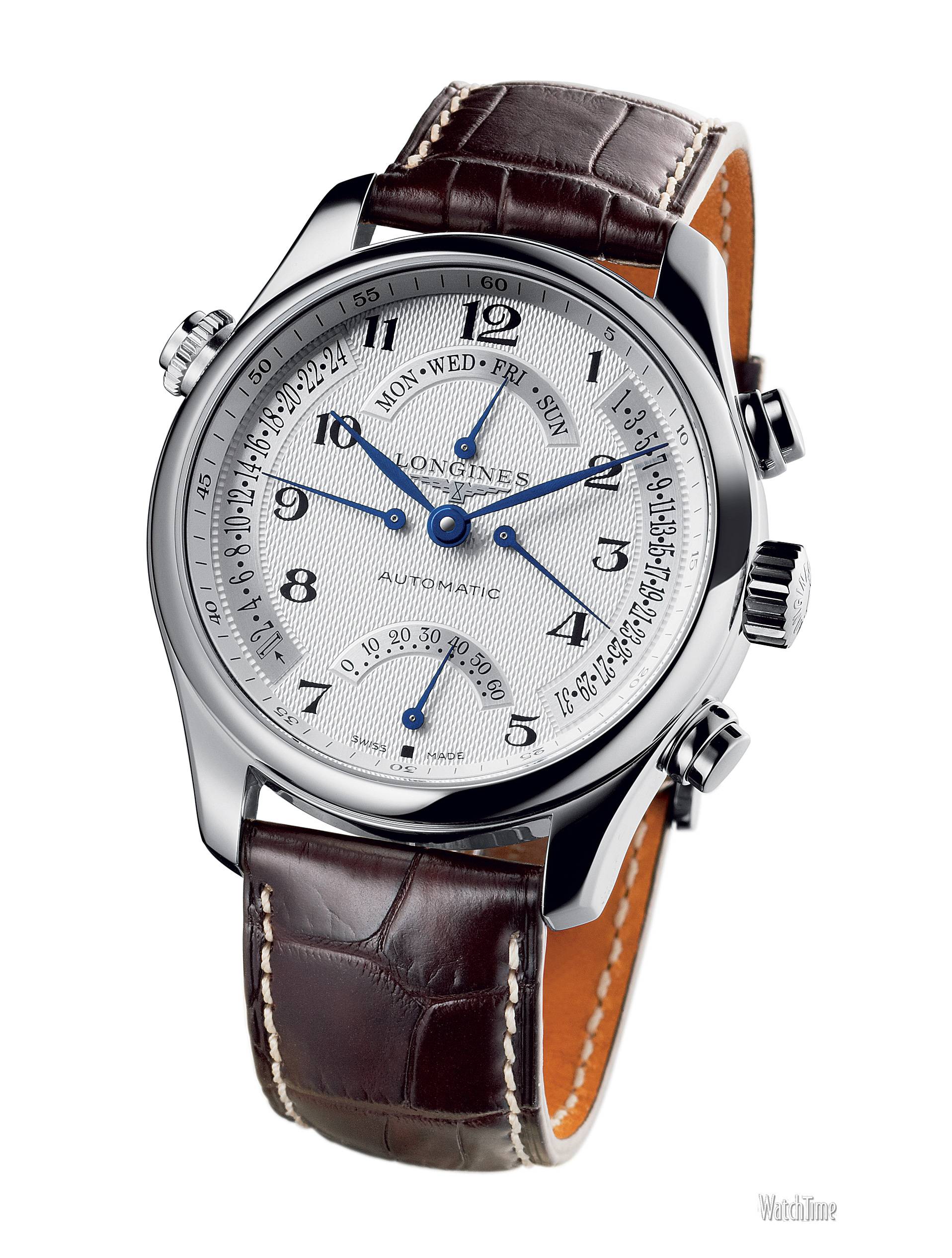
Close scrutiny of the movement reveals some unexpected attributes. The first surprise comes when you extract the crown to its middle position to set the time: the hand on the seconds display continues to run, but the hands on the three other retrograde displays abandon their previous positions and move clockwise into a sort of waiting position. A Teflon-coated guide ring ensures that the racks fall onto the cams and thus disengage simultaneously. When they’re in this position, the hour hand can be set in hourly increments without stopping the seconds hand or influencing the position of the minute hand. If you need to reset the minute hand, pull the crown out all the way and turn it. In this position, the seconds hand stays stopped where it was when the crown was fully extracted. There is no return-to-zero mechanism for the seconds hand; the movement’s developers decided not to include one because it would have made the watch significantly more expensive.
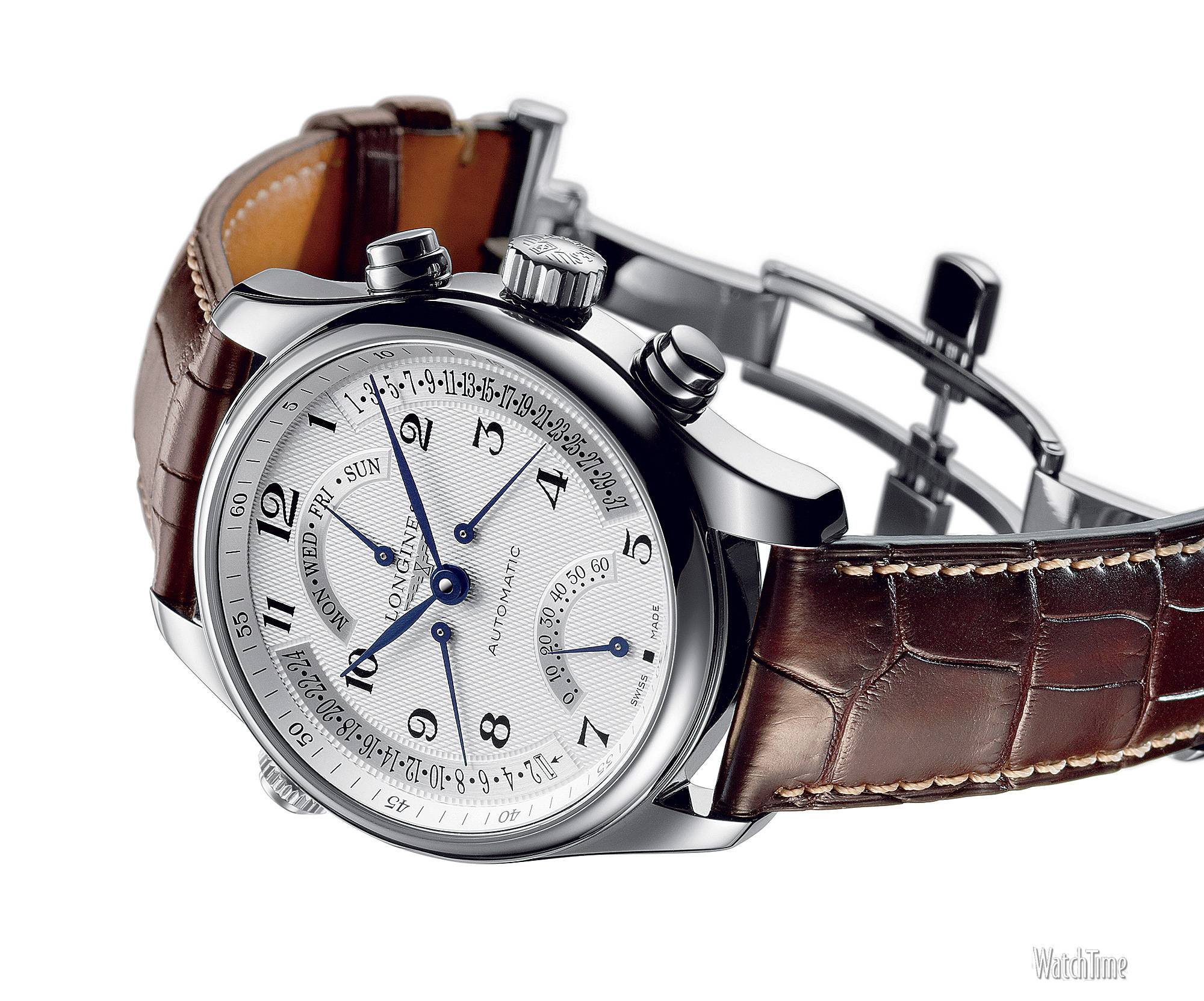
After the time has been set and the crown pressed back into place, the retrograde displays all return to their original positions. To set the day-of-the-week display, press the button at 2 o’clock to advance the display in single-day increments. The button at 4 o’clock is used to set the date display. So far, so good, and eminently simple, too. This watch has no 24-hour indicator for the hour hand, so the wearer must determine whether the hour shown on the dial is a.m. or p.m. Failure to take this detail into account may cause the date and weekday displays to advance at noon rather than at midnight. The simplest solution is to turn the hour hand through one full circle by extracting the crown halfway and then advancing the hand in a dozen single-hour increments. After the crown is pressed back in and the retrograde displays have returned to their positions, you can see if the hour has progressed past midnight, causing the date and day-of-the-week displays to move to their next positions. If you’ve inadvertently jumped to tomorrow’s date and day, simply turn the hour hand 12 hours back and the calendar displays will follow suit.
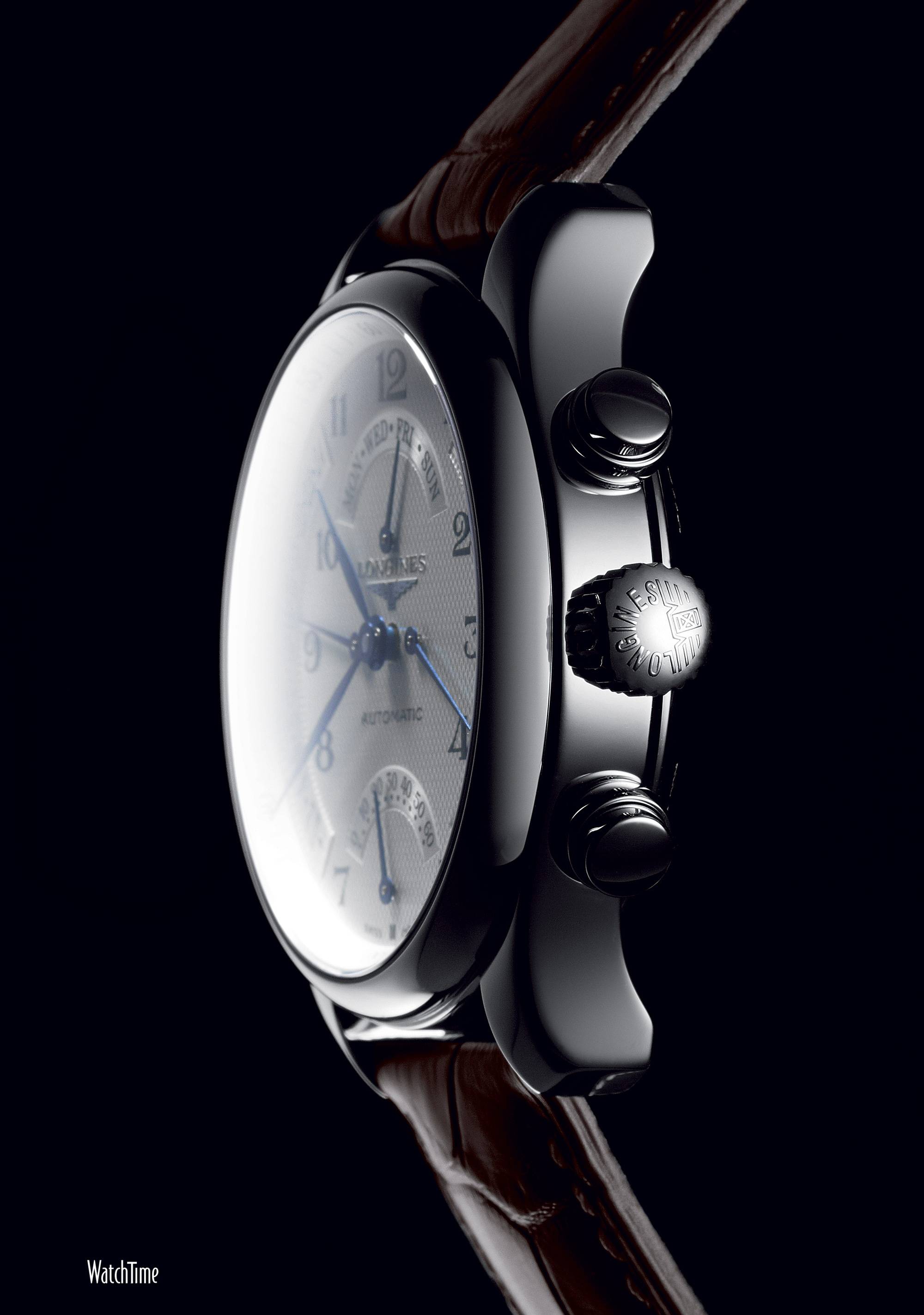
The threaded button at 10 o’clock repositions the retrograde display for the time in a second time zone. Following the motto, “better safe than sorry,” Longines put threading on this push-piece to prevent its being inadvertently pressed when the wearer bends his wrist. The time in a second zone can be set so that it’s independent of, and uninfluenced by, the ordinary hour hand. If you wish, you can set this display to show the time in a city outside your home zone (say you live in New York but want to keep track of the hour in London or Los Angeles) or you can use this display to keep track of the time back home while you’re on the road. The display of the hour in your home zone remains unaffected, even if you turn the ordinary hour hand forward or backward.
To read the full review click here.



Price and availability
I like this watch were can I buy it & also what’s the price
I own this watch and absolutely love the design of this timepiece. I do however also spent more then $1000 in maintenance and repairs on this watch which I consider rather steep over a 5 year ownership.
Nice watch plz send me price
I recently sold my master collection retrograde becouse the second hand lost accuracy over time. I still believe it is a very beautiful watch and I got a lot of complements. I believe if the second hand rotiated the watch would have worked more to my liking
This truly is a beautiful and remarkable timepiece and comes up as absolutely amazing in photos but in real life I just found the greatest problem was reading all the information off such a cluttered dial. Having all the functions in retrograde is fantastic but not so practical and easy to read.
I’ve owned a Longines Master Collection Retrograde as shown above on the stainless bracelet for a little over two years now and I am quite pleased with it – it has become one of my favorites! A quadruple retrograde at this price point presents an uncommon value and the watch often garners compliments. The accuracy has been more than acceptable and from a practical standpoint I have never perceived a difference between it and even the COSC certified chronometers in my collection. Perhaps my large wrist is particularly accommodating but I have never experienced any discomfort or scratches from the lugs. In fact, it’s one of the more comfortable watches I own encouraging me to wear it often for all but the most casual occasions. The blued hands are quite handsome befitting the classic look of this fine timepiece and the lack of a luminous dial is only slightly inconvenient as most watches perform no better after an hour in the dark. The Ball and Luminox examples in my collection serve me well for red-eye flights.