

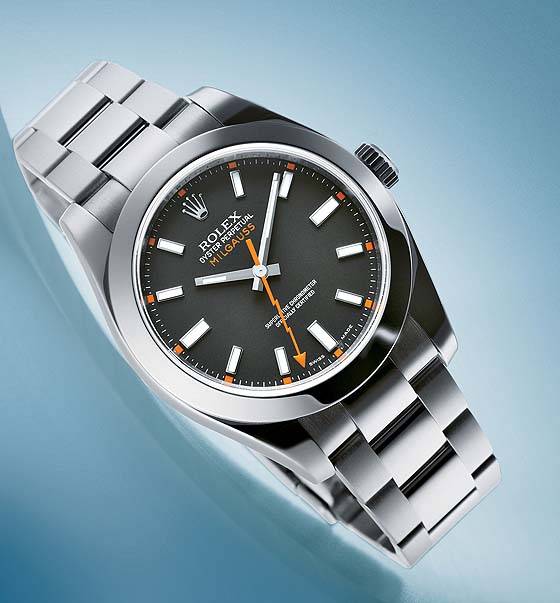
The updated version of the 1950s’ Rolex Milgauss is a hit among Rolex fans. Is this re-engineered classic, with its improved protection against magnetism, worth the investment? Writer Jens Koch and photographer Nik Schölzel find out in this test feature from the WatchTime archives.
Magnetic fields are invisible and do not greatly affect the human body. Maybe that’s why we don’t think about them very much, even though our high-tech world is full of them, generated by all sorts of devices, from motors to loudspeakers. Unlike the people who wear them, however, mechanical watches are extremely susceptible to magnetic fields. When parts of a watch’s movement become magnetized, its rate accuracy is disturbed, causing frustration for its owner.
Rolex addressed this problem in the 1950s with the introduction of its Oyster Perpetual Milgauss model. The name comes from the French mille Gauss, referring to the watch’s protection from magnetic fields up to 1,000 gauss (named after physicist Karl Friedrich Gauss, a gauss is a unit for measuring the strength of a magnetic field). This level of magnetism, which corresponds to 0.1 Tesla or 80,000 vph, is 100 times higher than that of a typical horseshoe magnet. It would take levels such as those found in an MRI scanner to affect the watch’s functioning. After devoting considerable time and effort to the development of the recent reissue of the Milgauss, Rolex introduced it at the Baselworld watch fair in 2007. Its inner case, made of ferromagnetic material, shields the movement from magnetic fields and consists of only two parts: a container and another cover tightly screwed to it. The container encloses the movement laterally and on the dial side, while the back seals the movement side. To ensure that the movement would be shielded as much as possible, the designers allowed for only a bare minimum of openings in the dial and case. This is why there is no aperture for a date display, for example. There are only the necessary small openings for the winding stem and for the axles that anchor the hands. There are also two tiny holes for the screws that hold the dial. Most other watches with magnetic protection have an inner case with three parts, with the parts layered on top of one another rather than threaded together.
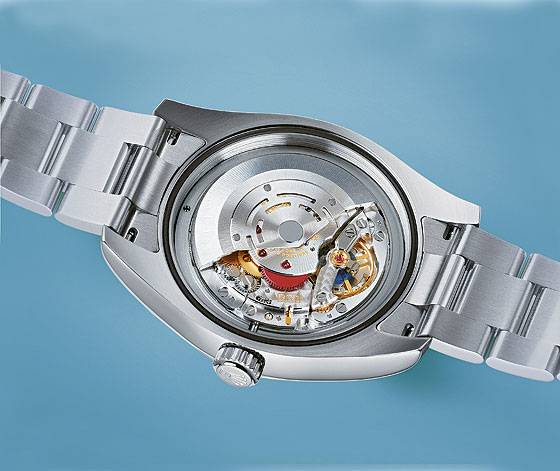
Rolex didn’t stop there; its engineers were determined to make additional modifications to prevent even minute amounts of magnetism from leaking into the movement. The result of this initiative was the blue Parachrom hairspring that appears in the Rolex Milgauss as well as other Rolex models such as the Daytona, the new GMT-Master II and the Yacht-Master II. It is made of a niobium-zirconium alloy with an oxide coating and remains completely unaffected by magnetic fields. It is also supposed to withstand shocks better than conventional hairsprings. (Click here to read WatchTime’s 2010 visit to the Rolex manufacturing facility in Bienne, Switzerland and learn more about how these Rolex-exclusive springs are made.) Additionally, the pallet fork and escape wheel are made of amorphous nickel-phosphorous, which is completely antimagnetic. Opening the solid, screw-down caseback reveals the second caseback made of soft iron. It can be opened with the same special wrench used for the outer caseback. This caseback is marked with a “B” with an arrow above it — the symbol for magnetic flux density — as an indication of its special function. (Interestingly, it is one of Rolex’s main competitors, Omega, that recently upped the ante on magnetism-resistant watches with the 2013 introduction of its Seamaster >1,500 Gauss, which uses even more antimagnetic materials in its movement; click here for more on that watch.)
Ticking behind that caseback is the automatic Caliber 3131. It differs from its close relative, the 3130, which is used in the Explorer and the no-date version of the Submariner, only by these modified materials. Caliber 3130 is in turn based on the well-known Caliber 3135 that powers the Submariner and Datejust models. Some watchmakers view this Rolex manufacture caliber as the best automatic movement on the market, due to its robust design, which also permits very precise rate adjustment. For example, a stable balance bridge replaces the usual balance cock that features only one point of support. The endshake of the balance can be adjusted with two knurled screws. The Breguet overcoil of the hairspring also ensures precision in every position, as does the free-sprung balance using Microstella nuts. The red anodized reversers in the automatic module minimize friction. The only criticism we could level at the movement is that its rotor axle is set in a jeweled bearing rather than in a more modern ball bearing. Nevertheless, there are no known problems associated with this caliber. There is no caseback viewing window, so you’ll have to remove the caseback to see the nicely designed movement and its decorations. The classic Rolex rotor with cutouts and the automatic bridge are decorated with a sunburst finish. Other bridges have a perlage finish. Every bridge and plate is rhodium-plated and the edges are beveled and polished. The carefully polished screw heads are especially attractive.
The rate results for the new Rolex Milgauss were good, though they were not as precise as other Rolex watches that have undergone the same tests. They showed an average deviation of only +1.5 seconds per day on the timing machine, and a stable amplitude with no strong deviation between the vertical and horizontal positions. However, the greatest deviation between the positions, at seven seconds, was a rather imperfect result. When worn on the wrist the watch gained three seconds per day. Operating the Milgauss, however, is simplicity itself. The crown is easy to unscrew and has only two positions for winding and setting the hands. A hack mechanism keeps the balance and hands in place, enabling the wearer to set the watch to the second with precision. The logo and markings on the winding crown — a Rolex “crown” emblem with a dash below it —denotes the Twinlock crown, a departure from the Triplock crown of the Submariner, Sea-Dweller, and other Rolex Professional models. At 7 mm this crown is considerably larger and easier to grasp than the crowns on other, similar watches. Download the full review here.
This article was originally published in 2014 and has been updated.
(Interestingly, it is one of Rolex’s main competitors, Omega, that recently upped the ante on magnetism-resistant watches with the 2013 introduction of its Seamaster >1,500 Gauss, which uses even more antimagnetic materials in its movement). CORRECTION: The Omega Seamaster you refer to is >15,000 Gauss NOT 1,500 Gauss. I get the feeling that this was not a typo but rather a patronizing attempt not to upstage Rolex. And while the Master Chronometer certified Omegas are rated at 15,000 Gauss anti-magnetic they are in fact resistant to 60,000 Gauss but the METAS testing device can only go to 15,000.
“Omega, that recently upped the ante on magnetism-resistant watches with the 2013 introduction of its Seamaster >1,500 Gauss”
The Omega is greater than 15,000 gauss not 1,500
Thank you.
Omega Seamaster is 15,000 Gauss, not 1,500.
What is a Videoscope, and How Does it Work?
I bought a submariner 5513 when I was 18yo….then a GMT II in my 40’s. At pre-retirement age, I just bought a Milgauss Z blue. Unlike the first two, this is a watch that you “learn” to love. At first glance, it looks special/a bit weird…then, the more you wear it, the more you like it. I recently bought a Rubber B black/pacific blue strap…it’s a fantastic everyday watch. Just beautiful. My only complain with my 3 Rolexes is that I can’t wear them all at the same time!
and now we are in 2016, this article ticks on like a Rolex.
Recently Jack Forster at Hodinkee tested two watches against an extremely powerful magnet, the Omega with a co-axial movement and a Rolex Milgauss. Despite the higher advertised magnetic resistance of the Omega, in reality both watches proved resistant to the magnetic field. This shows that Rolex is quite conservative with it’s advertised rating but is in fact A=magnetic to a ( much higher ) high level. This speaks well of Rolex and it’s testing and manufacturing standards I think. And for the price that is what we have a right to expect. My new Air King’s movement has only deviated by about +2 so far in a week.
The new Air King has the same system.
If you find your way here, I can attest that this watch (Black GV) is the perfect daily Rolex for me. The look is clean and purposeful yet interesting enough to make you smile every time you look at it, which you will often. I have a blue Yacht master and an SS Daytona. I was looking for a professional looking watch with a smooth, fixed bezel without the telltale date bubble that might draw a little less attention from non-WIS onlookers and yet still be a Rolex rather than say a Seiko Spring-Drive (which I think are also very cool). Perfect balance in diameter, height and weight on my 7.25 inch wrist. The new Rolex Oyster bracelets are superb, but as many know, the polished center links can be a little distracting. On the Milgauss GV this bracelet complements the look seamlessly with the polished case, bezel, hands and batons on the dial. Honestly, the antimagnetic properties appeal to me only because of the original heritage, which includes the lightning second hand found on early versions. The OMEGA Master Co-Axial movement has the Milgauss beat by miles in the anti-magnetic department. Accuracy has been +1.3 seconds per day. I’m very pleased. I may just but the Blue GV as well which, like the Black GV, looks fantastic in person. Cheers.
I like your analysis! I find the Milgauss dressy as well as sporty! I have a green sub and a ss Daytona!
I do not really wear either! For a daily wearer I was looking at a explorer I or II or maybe a ss Cartier diver! Perplexing isn’t it?
Not that it matter so much, but the watch on the picture above is not a GV. It is the now discontinued regular black dial Milgauss.
Maybe the ungliest rolex I have ever see…
Omega 15000 GAUSS no 1500!!! Without iron shield
What justifies the new Explorer II 42MM’s $2000 higher price than the Milgaus
The fact that this review was written years ago. Check the price today. I don’t believe you’ll find the difference to be so stark.
I have owned two of these watches for the past two years. They both have both the green crystals. I have one that I’ve never worn and is still in the original packing materials as the watches are in limited supply, and the other one I wear on a regular basis.
I am at Rolex collector but I must say that this watch and of course by Pres. rose gold on my two favorites.
Because of the parachrome hairspring, which comes standard in all Rolexes now, but, as i understand, was introduced in this watch, this watch remains the most accurate Rolex that I own.
I am extremely pleased with my purchase of this watch and it has brought me great pleasure in wearing it, though it does not have the “traditional” look of the Rolex except the traditional rolex bracelet, If you’re used to the standard Rolex, this is very much a pleasant change without compromising Rolex quality.