Aug 6, 2012
Reading time 10 min.
Annual Check-Up: Testing A. Lange & Söhne's Saxonia Annual Calendar
WatchTime takes the pulse of A. Lange & Söhne's Saxonia Annual Calendar, the first such complication for the Glashütte-based luxury watch brand, in this Watch Test feature from our archives. Click here to read the results and to marvel at Nik Schölzel's gorgeous photos of the watch.
In 2010, A. Lange & Söhne added an annual calendar to the long list of complications in its portfolio. This type of calendar adjusts itself automatically for the varying lengths of the months with 30 or 31 days: it “knows” which are which. An annual calendar is stumped only by February, which, of course, has either 28 or 29 days. When March begins, the owner must therefore move the date forward to the first of that month. An annual calendar is so named because it needs adjustment just once a year.
The company already had a perpetual calendar in its line-up, the Langematik Perpetual, when it launched the Saxonia Annual Calendar. Both watches have very similar, self-winding movements, and both have the same highly precise moon-phase display, which will be off by just one day after 122 years. The perpetual calendar nonetheless costs almost twice as much as the annual calendar. The Langematik Perpetual does have a couple of attractions that the Saxonia lacks: a leap-year indicator, found on many perpetual calendars, and a 24-hour display.
The Annual Calendar is more attractive than its Perpetual counterpart, thanks in part to the absence of these features. Eliminating both the small leap-year display, superimposed on the Perpetual’s month subdial, and the 24-hour display, which shares a subdial with the Perpetual’s day indicator, makes the Annual Calendar’s dial cleaner and easier to read, and also gives perfect east-west symmetry to the dial. A love of detail is evident in many places, such as the stalk-shaped indices, which are faceted on all four sides; the hands, which arch gently toward their tips; and the perfectly polished little moon that adorns the moon-phase disk.
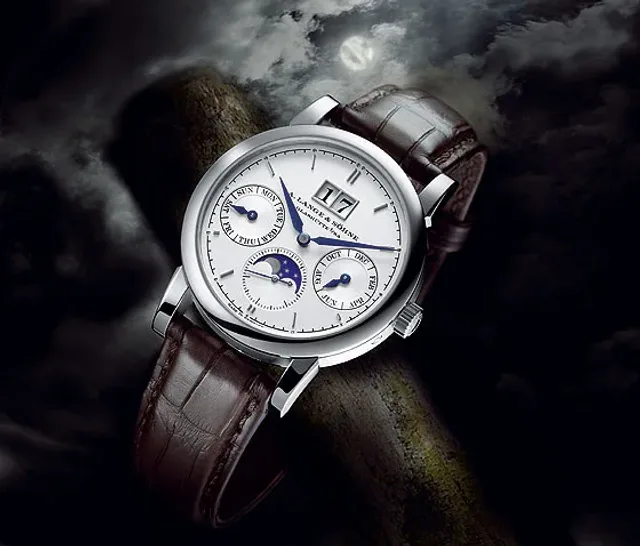
The dial has a perfect east-west symmetry.
PR
The designers of the Saxonia Annual Calendar have given it a very harmonious appearance; but because of precisely this quality, it doesn’t look quite as distinctive as some of this manufacture’s other notable creations, such as the Lange 1 or the Zeitwerk.
Lange has also made the watch very legible: the blued hands contrast strongly with the large silver dial. And the large date, with Lange’s standard double window, can be read at a glance. The months circle spells out only every second month. The watch is available with either English or German names for the days and months. However, more than a fleeting glance is needed to read the information displayed on these two subdials, and nothing on the dial is luminous. The nonreflective treatment on the crystal, which is made of sapphire, enhances daytime legibility. The crystal is so glare-free that it’s nearly invisible.
One of the watch’s minor shortcomings is that the date display takes half an hour to switch completely to the next day’s date: it starts to advance at five minutes before midnight. If the watch hasn’t been worn for several days, the wearer can quickly bring the calendar indicators up to date by pushing buttons set into the case: the big date is adjusted by a button at 10 o’clock, the day by one at 9 o’clock, the moon-phase by one 8 o’clock, and the month by one at 3:30. Each of these little buttons is pressed with the tip of a pen-like tool, which minimizes the risk of scratching the case. The buttons are neatly inset into the satin-finished middle part of the extremely well-crafted case, so they scarcely detract from the watch’s elegant appearance. The patented “zero-reset” hand-setting mechanism not only momentarily stops the balance, but also sends the seconds hand hurrying back to its starting position at the top of its subdial (which also contains the moon-phase display). This hand and the balance instantaneously resume moving when the crown is pressed in. This practical feature, which functions like a chronograph with a zero-reset heart cam on the stem of the seconds hand, makes it easy to synchronize the watch with a time signal.
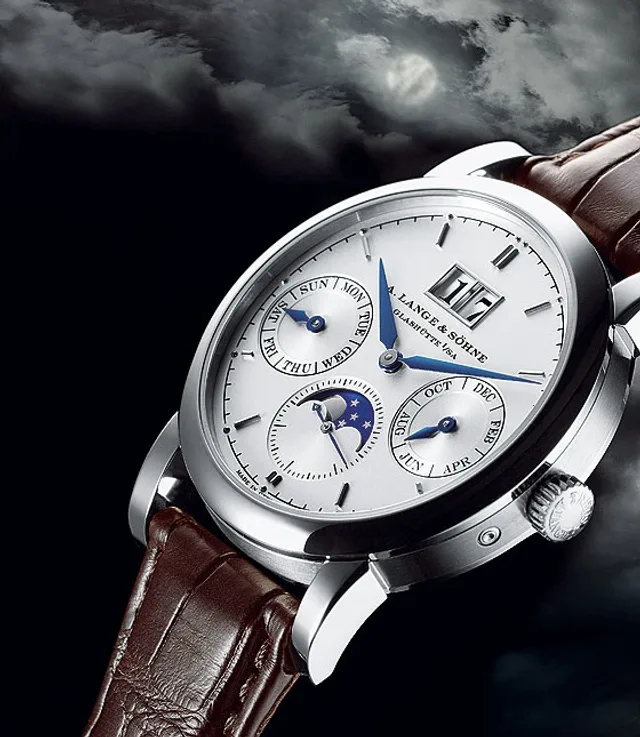
The calendar functions are adjusted using a pen-like tool to press buttons inset into the sides of the case.
PR
Although many watch lovers might have preferred a folding clasp, the pronged buckle is another practical detail. Thanks in part to its curved prong, this buckle cleverly guides the strap through it without the leather kinking and ensures that the strap wraps straight and flat around the wrist when the buckle is closed. An additional crossbar enhances the buckle’s stability. The wearing comfort here is better than that offered by a folding clasp because the pronged buckle is so flat and short that it can’t press uncomfortably against the skin. And, after all, a pronged buckle is really no more difficult to open and close than a belt buckle.
The case and clasp are neatly crafted and very meticulously polished. The crocodile-skin strap clearly shows that its makers have spared no expense or effort in its production: the scales on the leather are attractive and the strap is fully remborded. In this very laborious manufacturing method, the upper leather is wrapped around the sides and the lining, glued and then stitched together with the inner leather. The sewing is done by hand with saddle stitches.
Along with the very supple strap, the case’s lightness (less than 100 grams) and slim construction (under 10 millimeters) combine with the smooth plane of the sapphire window in the caseback to ensure that the Saxonia feels very comfortable on the wrist.
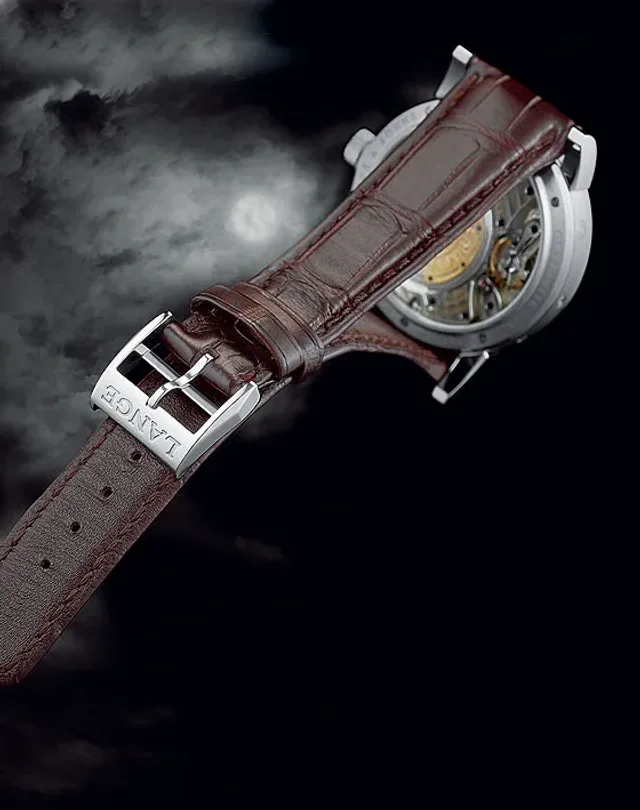
The supple, crocodile-skin strap is hand-stitched and fully remborded.
PR
Like the crystal over the dial, the one on the back is nonreflective and nearly invisible, thus providing a perfect view of the Sax-0-Mat self-winding Caliber L.085.1. This movement, like all Lange movements, has been elaborately embellished. The 21-karat-gold, three-quarters rotor is adorned with a beautifully crafted relief engraving of the words “A. Lange & Söhne.” Furthermore, the three-quarters plate, as well as the bridges and cocks (made of nickel silver) bear various decorative patterns such as Glashütte waves, circular graining and sunbursts. The hand-engraved balance cock is one of the company’s specialties, as are the swan’s-neck fine adjustment mechanism and the mirror-polished cover plate on the escape-wheel cock. A connoisseur’s gaze will also notice a screw balance, blued screws with polished heads, and chamfered and polished edges.
The movement is as well-made as it is beautiful. The ball-borne rotor, which has a platinum rim, winds the mainspring in both directions of rotation. Four ball bearings in the reversing and reducing gear train guarantee smooth running. The mechanisms for the annual calendar are hidden on the other side — that is, under the dial.
So how does Lange’s Annual Calendar work? The hour wheel propels a 24-hour wheel, which bears a lone switching finger. Each day at midnight, this finger propels the day and the moon-phase displays one increment ahead, and also acts via the main lever to move the 31-day wheel one position forward. The 31-day wheel also advances the month wheel whenever the former switches from the 31st of one month to the first of the next. But how does the mechanism “know” what to do at midnight on the last day of a 30-day month? This “knowledge” is encoded in a stepped cam on the axle of the month wheel. The cam, the so-called “months program wheel,” has notches that correspond to the 30-day months. These notches ensure that a rocker with a pawl is properly deflected. In the course of the daily switching process, the main lever also propels this pawl, which attempts to advance a spiral cam mounted on the 31-day wheel. This attempt succeeds only at the end of each month, when the pawl is allowed to touch the spiral cam. This contact occurs on the 30th day of 30-day months because the pawl and the rocker are both deflected farther outward by the months program wheel.
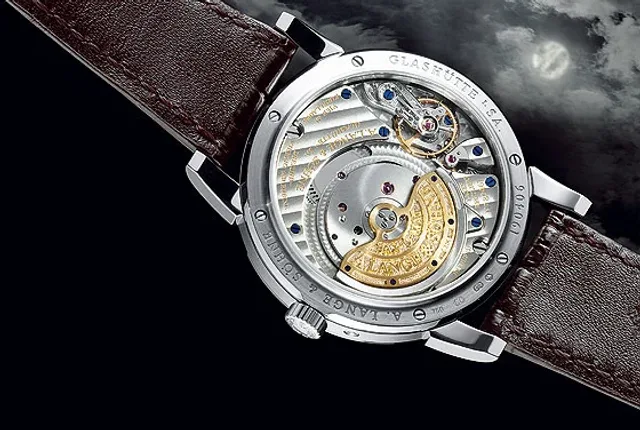
The movement’s decorative touches include Glashütte waves, circular graining and sunbursts.
PR
A technically savvy reader will no doubt already have realized that this architecture is very similar to that of a perpetual calendar, especially because the months program wheel has 48 increments and rotates once every four years so that an additional reduction gear is needed for the months display. If you compare this with the construction of the perpetual calendar in the Langematik Perpetual, you’ll discover that the two mechanisms are indeed technically identical. The only differences are that the Perpetual’s 24-hour and leap-year hands are missing on the Annual Calendar, and the increments for the Februaries are shallower on the months program wheel of that watch. It thus comes as no surprise to learn that the Annual Calendar caliber, with 476 components, has the same height and only two fewer parts than the Perpetual Calendar caliber.
For comparison’s sake, imagine that Porsche offers an entry-level roadster that costs only half as much as a 911. And keep dreaming that the only difference between the two is that the tires on the lower-priced car are designed for a maximum of 100 miles per hour rather than 200 mph. Now wake up: this is surely not a typical scenario for the world of automobiles and neither is it usual among watches. Other annual calendars (for example, from Patek Philippe) are much simpler and were designed independently of the brand’s perpetual calendar.
Lange’s approach is all the more surprising because a perpetual calendar is only so costly because it’s so complex. Apparently it would have been more expensive to develop a calendar mechanism expressly for the Annual Calendar than simply to modify the mechanism already used in the Langematik Perpetual watch. Be that as it may, the purchaser of a Saxonia Annual Calendar can be happy about getting nearly all the complex technology of a perpetual calendar, while paying a price that’s only slightly more than that of the Lange 1 Moon Phase.
Some people claim that complicated wristwatches are often not especially accurate timekeepers. This is at least partly true for the Saxonia Annual Calendar: although a calculated deviation of zero seconds across all positions is absolutely as good as it gets, the individual values are spread a full 11 seconds apart, and the amplitude declined a relatively large 27° between the flat and hanging positions. On the wrist, our tested watch gained two to four seconds per day.
The Saxonia Annual Calendar has no major weaknesses. It’s especially appealing thanks to its attractive design, a beautifully decorated manufacture movement, a practical calendar complication, good legibility and the outstandingly high standards of quality upheld in the production of all its components. The price is reasonable, too, considering the complicated calendar mechanism.
PROS
+ Harmonious design
+ Excellent craftsmanship
+ Beautiful manufacture movement
+ Easy-to-read date
CONS
– The date display switches slowly
– Less than ideal rate results
SPECS
Manufacturer: Lange Uhren GmbH, Altenberger Strasse 15, D-01768 Glashütte, Germany
Reference number: 330.026
Functions: Hours, minutes, seconds, large date, day, month, moon- phase
Movement: L085.1, automatic; 21,600 vph; 43 jewels; Kif shock absorbers; Glucydur balance; swan’s-neck fine adjustment mechanism; hand-engraved balance cock; diameter = 30.4 mm; height = 5.4 mm; 46-hour power reserve
Case: White-gold case, nonreflective sapphire crystal, six screws hold back in place, exhibition caseback with non-reflective sapphire window, water-resistant to 30 meters
Strap and clasp: Hand-sewn crocodile-skin strap, white-gold pronged buckle
Rate results (Deviations in seconds per 24 hours):
Dial up +7
Dial down +5
Crown up –3
Crown down –3
Crown left –4
Crown right –3
Greatest deviation of rate 11
Average deviation 0
Mean amplitude:
Flat positions 321°
Hanging positions 284°
Dimensions: Diameter = 38.5 mm, height = 9.8 mm, weight = 96 grams
Variations: Rose gold ($38,400)
Price: $39,600
SCORES
Strap and clasp (max. 10 points): The elaborately polished pronged buckle minimizes wear on the beautiful, hand-sewn, crocodile-skin strap. 9
Operation (5): When the easy-to-operate crown is pulled out, the seconds hand hurries to its zero position and remains there; in order to prevent scratching of the case, a little pen-like tool is provided for pushing the inset buttons that adjust the calendar settings. 4
Case (10): The case is well crafted and meticulously polished; the nonreflective treatment is excellent on the front and back crystals. 9
Design (15): The dial’s harmonious and symmetric arrangement contributes to the watch’s attractive overall appearance. 14
Legibility (5): The most important displays (i.e., hours, minutes and large date) are easy to read at a glance; the day of the week and the month are smaller, but still easily legible. 4
Wearing comfort (10): This watch is comfortable to wear thanks to its slim, lightweight case, not-too-stiff strap and practical, pronged buckle. 9
Movement (20): A manufacture movement of the finest sort: three-quarters plate, gorgeous manually executed embellishments, and a complication that’s technically nearly identical to that of a perpetual calendar. 18
Rate results (10): The relatively large spread among the deviations in the various positions resulted in a perfect calculated average deviation; the watch gained slightly on the wrist. 6
Overall value (15): Well-priced compared with other Lange watches. 13
TOTAL: 86 POINTS
Receive all the news, features and reviews from WatchTime for free! Sign up to our free weekly newsletter and get all the news delivered to your inbox.