Feb 15, 2010
Reading time 5 min.
Vacheron Constantin La Symbolique des Laques: 600 Years In The Making
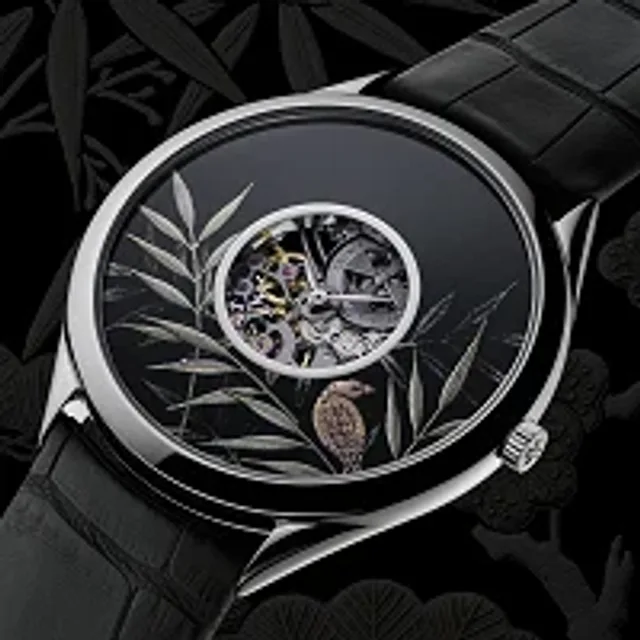
 At SIHH, Vacheron Constantin unveiled the new Métiers d’Art collection, La Symbolique des Laques. The collection combines two ancient arts: watchmaking and maki-e. Vacheron, which dates to 1755, joins with Japanese maki-e masters Zôhiko, founded in 1661 and together, their more than 600 years of history combine to produce these masterpieces of functional art.
What is Maki-e?
Maki-e literally means “sprinkled picture” and it is the most sophisticated of all lacquer techniques, designating a decorative operation in which the design is created by delicately sprinkling gold or silver dust over lacquer – usually black – while it is still wet.
The lacquer is made from the sap of the lacquer tree, Rhus verniciflua. This tree originated on the high plateaus of central Asia or Tibet. Today, it grows only in southern China, Korea, Vietnam and Japan, but it seems to have had a much wider range in the past. In Japanese, the word for the substance and the name of the tree are the same: urushi.
Maki-e was developed early in Japanese history. It matured as an art form between the eighth and twelfth centuries A.D., becoming the predominant method of ornamentation beginning in the seventeenth century and remaining so to this day. As with watchmaking, highly-skilled craftsmanship is required to produce a maki-e painting. It takes many years for an artist to become a maki-e master.
Each dial in this collection is hand crafted by maki-e master Mr. Yamamoto. As shown below, layers or black lacquer or urushiare applied to the solid 18-carat gold dial base and carefully polished.
 The artistic image on the dial is built up layer by layer as urushi is carefully applied and gold powder is sprinkled over it. Below, clockwise from the top left, we see the urushi being mixed, then applied to the lacquer base with an extremely fine brush. In the next image, gold powder is sprinkled over the fresh urushi, and in the final image, excess powder is removed with a soft brush.
 Each timepiece has a double face, lacquered using the maki-e technique. Behind these exquisite dials lies Vacheron Constantin Caliber 1003, developed and crafted in-house. For these pieces, the movement is created in 14-carat white gold and skeletonized. Each timepiece measures 40 mm in diameter.
Below, the Pine Tree and Crane timepiece showing both dials, and Caliber 1003
Each timepiece has a double face, lacquered using the maki-e technique. Behind these exquisite dials lies Vacheron Constantin Caliber 1003, developed and crafted in-house. For these pieces, the movement is created in 14-carat white gold and skeletonized. Each timepiece measures 40 mm in diameter.
Below, the Pine Tree and Crane timepiece showing both dials, and Caliber 1003
The artistic image on the dial is built up layer by layer as urushi is carefully applied and gold powder is sprinkled over it. Below, clockwise from the top left, we see the urushi being mixed, then applied to the lacquer base with an extremely fine brush. In the next image, gold powder is sprinkled over the fresh urushi, and in the final image, excess powder is removed with a soft brush.
Each timepiece has a double face, lacquered using the maki-e technique. Behind these exquisite dials lies Vacheron Constantin Caliber 1003, developed and crafted in-house. For these pieces, the movement is created in 14-carat white gold and skeletonized. Each timepiece measures 40 mm in diameter.
Below, the Pine Tree and Crane timepiece showing both dials, and Caliber 1003
The Collection and the Symbolism
The symbolique des laques theme will change over a period of three years, with each year bringing a new set of three watches in a limited series of twenty. The first set shown here explores the theme of long life with “The Three Friends of Winter": the pine tree, bamboo, and the plum tree. By virtue of their resistance to extreme cold, the “Three Friends of Winter” symbolize longevity, and by extension, they are also associated with the loyalty of a friendship that survives the hard times, symbolized by winter.
Each of the “Three Friends of Winter” is paired with a bird. For example, the long-lived pine is accompanied by the crane, whose whiteness recalls the accumulation of years. Bamboo is associated with the sparrow, whose ceaseless activity symbolizes the vitality of the continually renewed bamboo. Finally, the plum tree is matched with the nightingale, because both celebrate the arrival of spring, one with its early flowers and the other with its song.
The main design of the tree on the front of the watch is matched by the bird design on the back, facing the wrist. The choice to include maki-e on both sides of the watch falls within a Japanese tradition, as many Japanese lacquerware objects are decorated even on their hidden surfaces, for example, on the insides of lids or the bottoms of boxes.
Bambou and Sparrow
Up close, the amazing detail and craftsmanship are evident (click to enlarge)
Plum Tree and Nightingale
Zôhiko
In 1661, Yasui Shichibei opened a shop he named Zôgeya, where he sold lacquerware. The shop remained in the family for five generations before passing to Nishimura Hikobei, then head of production, because there were no heirs in the Kusunoki branch. From that day down to this, Zôhiko has been run by members of the Nishimura family, each of whom has taken the founder’s first name. Zôhiko’s current director is the ninth Nishimura Hikobei.
The third Hikobei (1806-1875) was granted the title “Master of maki-e” by the Emperor for the excellence of his work. One of his most remarkable pieces is a maki-e panel representing the Fugen Bodhisattva on a white elephant. History says that the people of Kyoto were so charmed by the beauty of this image that they named it the “Zôhiko panel,” with “Zô” meaning the elephant and “Hiko” being the first part of Hikobei’s first name. This is the origin of Zôhiko’s company name.
Zôhiko has a longstanding relationship with the Japanese Imperial Court. The fourth Hikobei was one of the Court’s official suppliers, and the current director made the reigning emperor’s official seat. The workshop’s first exports date to the very end of the nineteenth century, upon Japan’s opening to abroad after the Meiji restoration. The company’s expanded horizons were the work of the eighth Hikobei (1887-1965). He was unanimously considered to be a pioneering figure in the lacquer industry. He also founded a maki-e school that became a standard of reference for many specialized lacquer artists.
The Métiers d’Art – La symbolique des laques is a limited series of 20 sets of three watches each per year. Each set is priced at SFr. 272,500.
Additional technical information
References 33222/000R-9506 – Pine Tree and Crane
33222/000R-9517 – Plum Tree and Nightingale
33222/000G-9521 – Bamboo and Sparrow
Movement 1003 SQ, skeletonised, 14-carat gold, ruthenium treated
Developed and crafted in-house by Vacheron Constantin
Stamped with the Hallmark of Geneva
Energy: Mechanical hand winding
Movement thickness: 1.64 mm
Movement diameter: 20.80 mm
Jewels: 18 jewels
Frequency: 18,000 vibrations/hour
Indications: Hours, minutes
Power reserve: More 30 hours
Case: 18-carat 4N rose gold
18-carat white gold
Diameter: 40 mm
Water resistance: 3 bar, equivalent to 30 metres
Dials: 18-carat gold coated with Japanese maki-e lacquer
Strap: Black alligator leather, large square scales
Hand-sewn, saddle-stitched
Clasp: Buckle in 18-carat 4N rose gold or 18-carat white gold
Polished half Maltese Cross