Ad
Ad
Ad
Ad
Ad
Ad
Reading time 5 min.

5 Milestone Breitling Watches, from 1915 to Today
Pilots rely on Breitling’s chronographs, but calendars, world timers and divers’ watches also are part of the brand’s 130-plus-year history. As we all digest and discuss the redesigned Navitimer models that Breitling announced last week, let['s look back on five important Breitling watches that helped define the brand's identity from 1915 through the modern day.
Breitling_Milestones-Emergency_650FI
© PR
Pilots rely on Breitling’s chronographs, but calendars, world timers and divers’ watches also are part of the brand’s 130-plus-year history. As we all discuss the redesigned Navitimer models that Breitling launched this year, let's look back on five important Breitling watches that helped define the brand's identity from 1915 through the modern day.

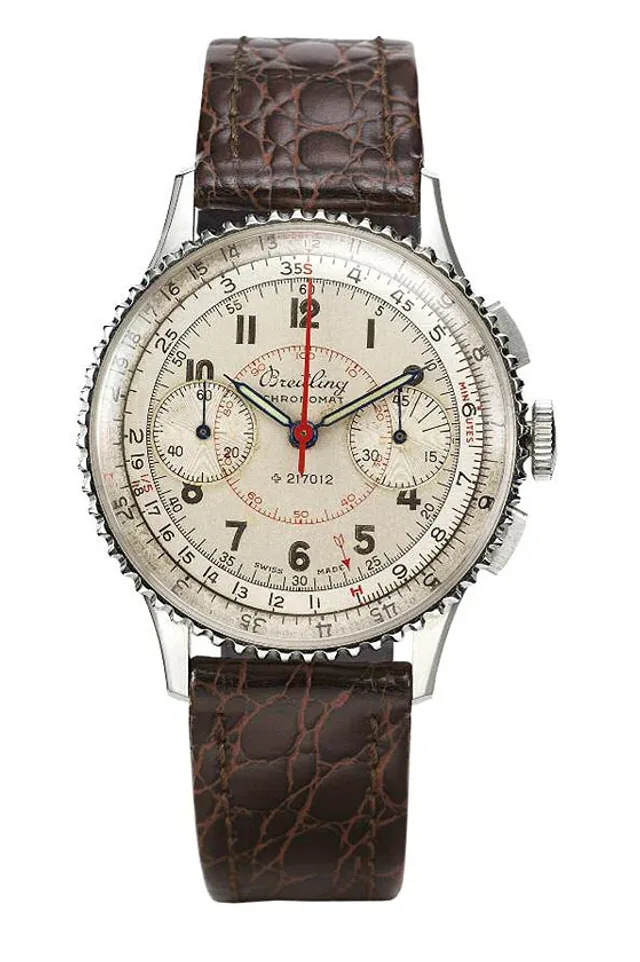
1. Breitling Chronomat

Breitling ChronoMat - 1941
Breitling Chronomat (1941) © PR
Launched in 1941, the Breitling Chronomat was based on a patent document that Breitling submitted in 1940: patent number 217012 granted protection for an instrument-style wristwatch with a circular slide rule. This clever system made it quick and relatively easy to perform various measurements and mathematical operations, e.g., the conversion of speeds or distances from one unit of measurement to another, multiplication, division, and cross-multiplication. This new timepiece attracted many aficionados in sports and industry, and technicians appreciated its special features, which made their work easier. Later versions of the Chronomat with different cases and dials were the earliest ancestors of Breitling’s legendary Navitimer. The watch shown here contains Venus Caliber 175. A special feature of this watch is a counter for 45 elapsed minutes – a detail welcomed by soccer fans.

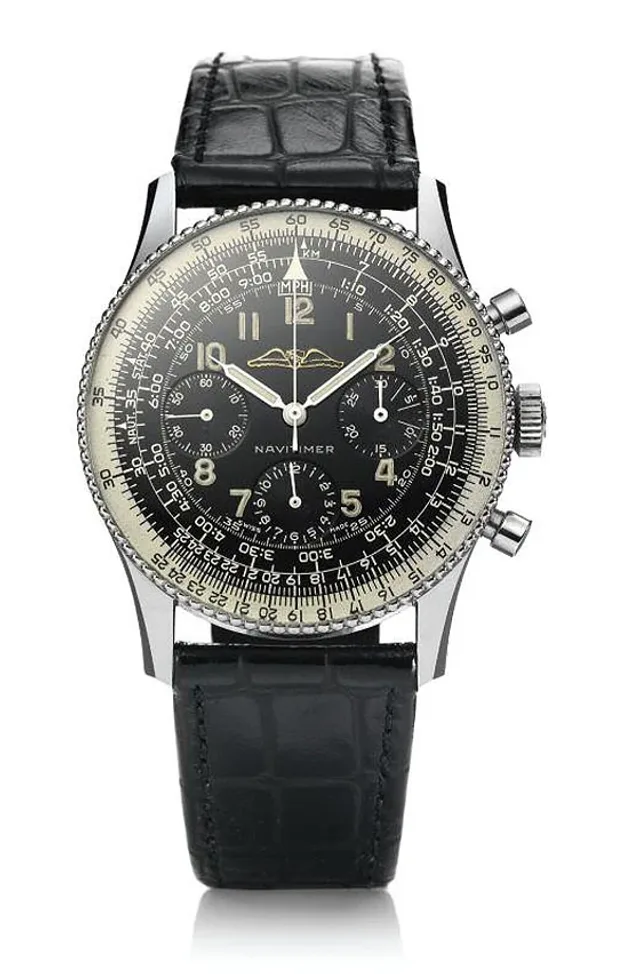
2. Breitling Navitimer

Breitling Navitimer - 1952
Breitling Navitimer (1952) © PR
Don’t be misled: this watch’s name, which was trademarked in 1955, has nothing to do with the navy. The Breitling Navitimer, which debuted in 1952, was designed to help pilots coordinate time and navigation: it was equipped with calculating functions. Advertisements described this multifunctional device, which contained the hand-wound Caliber Venus 178, as a “personal onboard instrument.” The built-in slide rule enabled aviators to multiply and divide, convert nautical miles to land miles, and calculate averages, fuel consumption, average gain of altitude, and distances during ascent and landing. Fumbling with paper and pencil while in flight could be at least partially eliminated. Since it was introduced, the Navitimer has undergone various changes, mainly to its case and the calibers it housed, i.e., hand-wound, hand-wound with date, or self-winding, but no one has ever tampered with its most distinctive feature: its circular slide rule.

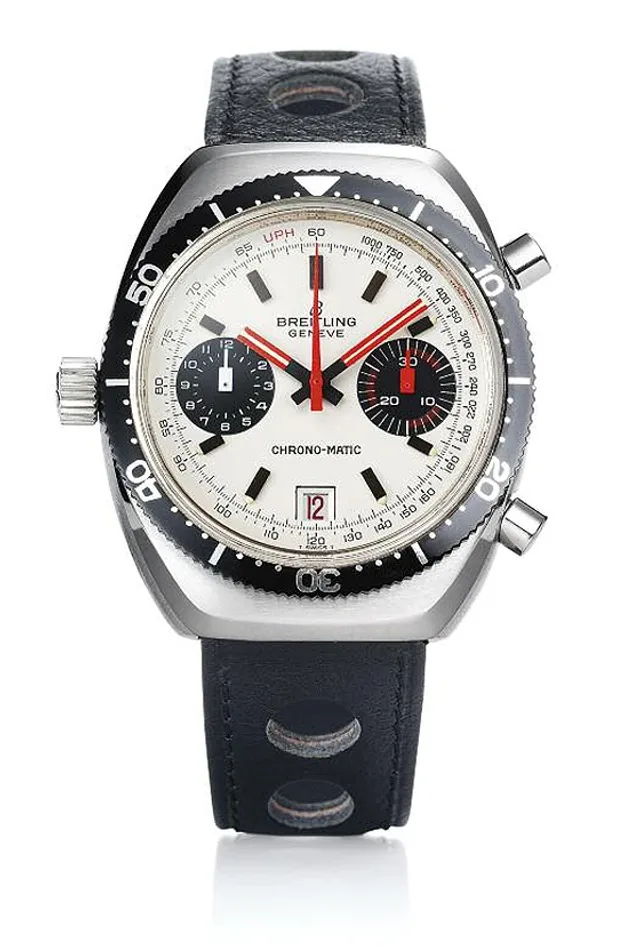
3. Breitling Chrono-Matic

Breitling Chrono-Matic - 1969
Breitling Chrono-Matic (1969) © PR
Sales of chronographs declined markedly during the second half of the 1960s. Breitling and its competitor Heuer formed a partnership to develop the first automatic chronograph and hoped that its launch would help counteract the downturn. The adventure began in 1965, when the two firms, along with Büren Watch and Dubois Dépraz, signed a contract to develop the watch; they called the venture Project 99. Büren was taken on as movement supplier because of its experience with micro-rotors. No other type of self-winding caliber could permit the rearward and thus service-friendly installation of the specially developed chronograph module because the small oscillating weight didn’t interfere with the two arbors of the elapsed-time counters. Furthermore, the date ring was positioned directly under the dial. Modular architecture also made it possible to install the crown on the left side, where it clearly showed that this was a self-winding watch. Breitling and Heuer (now TAG Heuer) were responsible for the design, the dials, the cases and the other components. The first prototypes of Caliber 11, which ran at 19,800 vph, were available in the spring of 1968. The official launch of the Breitling Chrono-Matic, the world’s first automatic chronograph with micro-rotor, took place simultaneously in Geneva and New York on March 3, 1969. When the curtains rose, the project had already consumed about half a million Swiss francs.

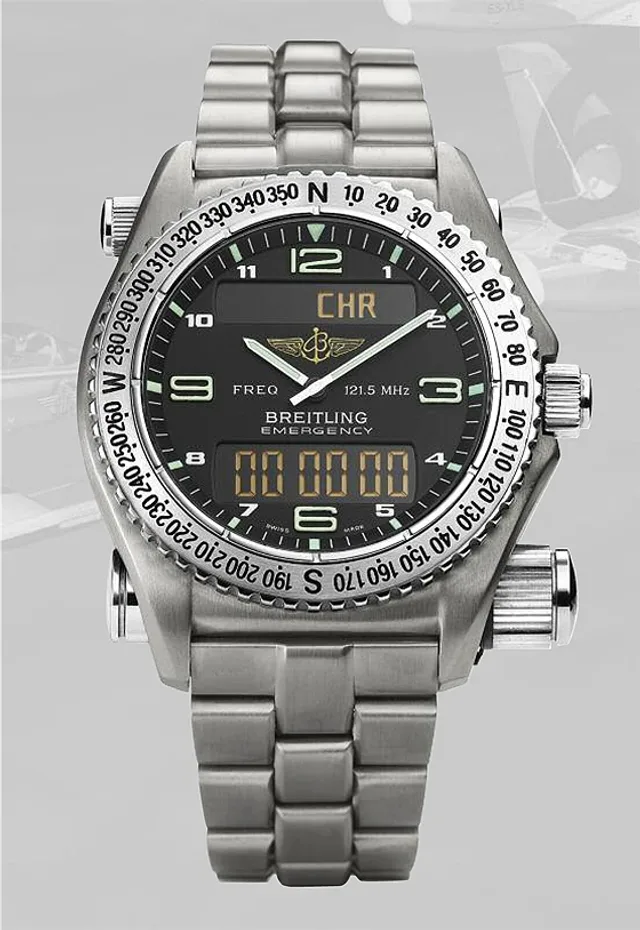
4. Breitling Emergency

Breitling Emergency - 1995
Breitling Emergency (1995) © PR

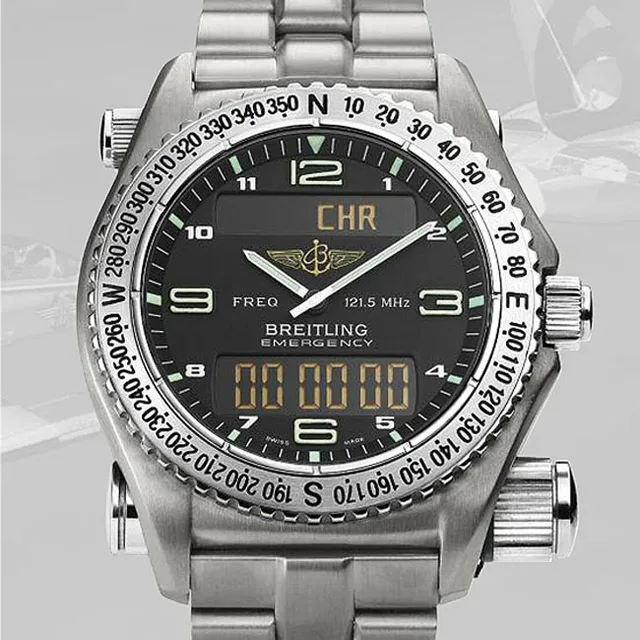
The Breitling Emergency, which debuted in 1995, was designed to save lives in critical situations. The Breitling Emergency was developed in collaboration with professional pilots. Breitling equipped the flip-open case of this big titanium watch with a micro-transmitter set to the international air distress frequency of 121.5 MHz. The transmitter of the Breitling Emergency could send signals via an extendible wire antenna if the wearer needed help. Once activated, the transmitter would repeatedly emit a 0.75-second impulse every 2.25 seconds. If transmitted from flat terrain, the signal could be received within 160 kilometers (99.4 miles) of the disaster site by search planes flying at an altitude of 6,000 meters (19,685 feet). Two lithium batteries in the Breitling Emergency provided enough power to keep the transmitter operating for 48 hours. The electronic time-measuring module, which could measure elapsed intervals to the nearest 1/100 of a second, also had a countdown function, an alarm, and a time display in a second zone. This information was shown in digital form. Pilots in aerobatic squadrons from many nations chose to wear these watches. (Click here to read about the newest version of the Emergency, the Breitling Emergency II.)

5. Breitling Transocean Chronograph Unitime
Breitling Transocean Unitime - 2012
Breitling Transocean Unitime (2012) © PR
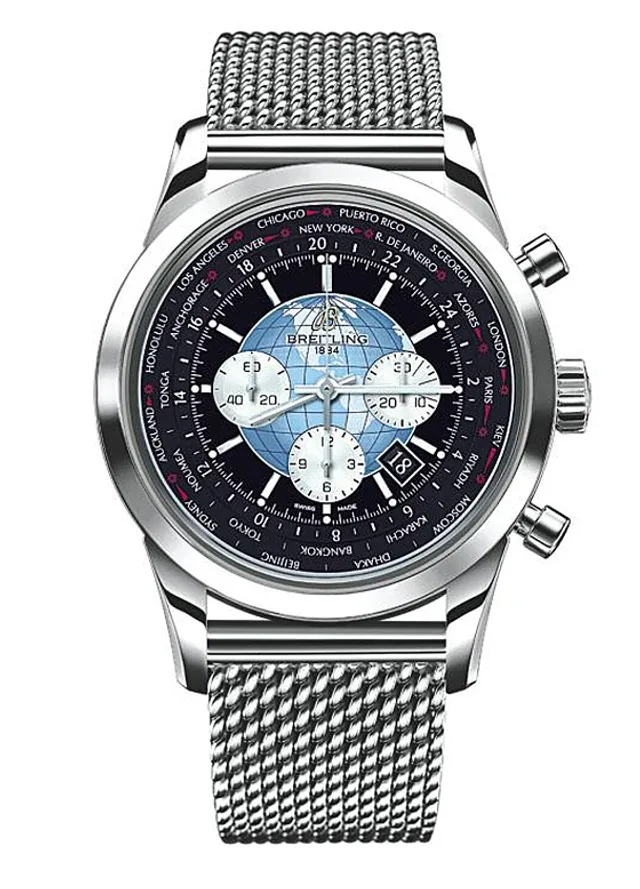
Breitling’s headliner for 2012 followed in the footsteps of its world-timer Unitime, which made its debut in 1951. From a technical and functional standpoint, the new watch, the Breitling Transocean Chronograph Unitime, was light-years ahead of its historical predecessor. The improvements began with the self-winding manufacture chronograph movement and continued with the mechanism under the dial. All indicators could be set and adjusted, either forward or backward, via the crown. When a traveler reaches his destination, he rotates the new reference city to 12 o’clock. This action triggers the central hour hand, the date display and the 24-hour ring to reset themselves automatically; only the minutes and seconds hands continue to run unaffected. The technicians also thought of daylight savings or summer time: they included little sun symbols on the city ring that could be used to make one-hour corrections. Breitling offers the city ring with the cities’ names written in several languages. The 46-mm case is water resistant to 100 meters and, like all Breitling watches, is COSC certified. For more detail on the Transocean Chronograph Unitime, click here. To read the entire list of 20 milestone Breitling watches, including the stories behind iconic watches such as the Breitling Superocean, Breitling Avenger and Breitling Cosmonaute, download the full article for just $5.99 from the WatchTime online shop. Merken Merken Merken Save Save
Archiv

Latest Articles

Hands-on with the D1 Milano D-Tech Oil II - Oil-filled fun
Filling a watch case entirely with oil doesn't sound like a good idea, yet it has its benefits. Many brands have done this over the years, and now D1 Milano offers one at an attractive price point with a compelling design, but how will it be on the wrist? Let's find out!
4 minutes
Jul 7, 2026
Vacheron Constantin Drops New 34.5mm Overseas Self-Winding Models - Smaller size, same great entrance
Vacheron Constantin expands the Overseas collection with two new 34.5mm self-winding models in rose gold and stainless steel. Featuring striking lacquered dials, interchangeable straps, and refined proportions, the latest additions combine everyday versatility with the unmistakable sporty elegance of the collection.
3 minutes
Designed with German Firefighters, Hanhart Launches the Thermosphere - "Call 112"
Developed together with a German Firefighters Association, the Thermosphere translates the timing structure of a breathing-apparatus operation into a purpose-built tool watch. Limited to 112 pieces, the watch pays tribute to the men and women who work against the clock when every minute matters.
4 minutes

You might also be interested in

Rado Expands Captain Cook Collection with Blue High-Tech Ceramic Chronograph - Metallic sheen, no metal
Rado introduces a striking new blue edition of its Captain Cook High-Tech Ceramic Chronograph. Combining a deep-blue dial and ceramic bezel with a plasma high-tech ceramic case, the latest model blends dive-watch capability with contemporary materials and refined aesthetics.
3 minutes
Jun 26, 2026
H. Moser & Cie. Introduces the Endeavour Flyback Chronograph Dual Time Date - Three complications, one intuitive display
Combining a flyback chronograph, dual-time display, and date indication, H. Moser & Cie.’s latest Endeavour model showcases remarkable mechanical complexity through an exceptionally clean and intuitive design.
3 minutes
Maurice Lacroix Debuts Pontos S Solar Duo - Light-driven sports performance
With the new Pontos S Solar and Pontos S Solar Chronograph, Maurice Lacroix expands its sportiest line for the first time with Swiss solar quartz movements, pairing light-powered efficiency with robust 200-meter water resistance and a distinctly summer-ready aesthetic.
3 minutes
Jun 21, 2026
Ad
Ad
Ad
Ad
Ad